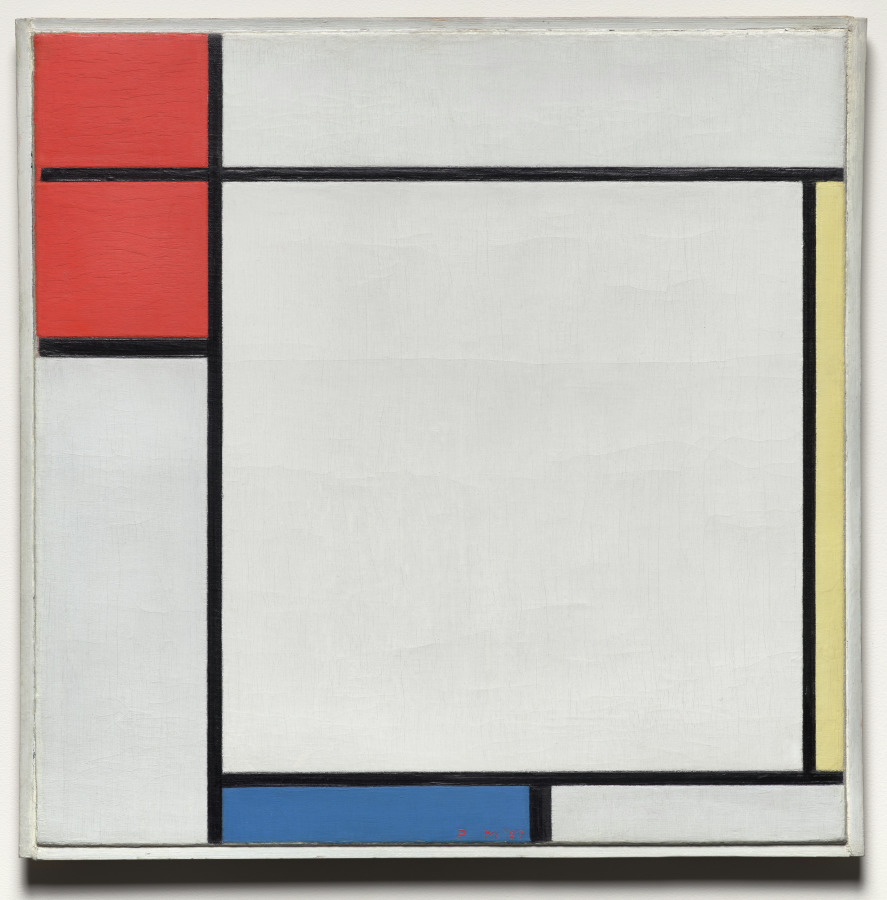
Urban Form: Composition with Red, Yellow, and Blue
Executive Summary: The Dialectic of Presence and Absence in Urban Silhouette
The 2026 NYC executive wardrobe demands a recalibration of form—a shift from narrative-driven aesthetics to a poetics of structural silence. Drawing from the juxtaposition of Jacques-Louis David’s “The Death of Socrates” and the ancient Greek Jar, this analysis deconstructs two opposing yet complementary modes of visual existence: “total presence” (the heroic, declarative form) and “silent implication” (the functional, receptive void). For the urban professional, the garment is no longer a canvas for biography but a container for time—a minimalist shell that absorbs the city’s velocity without theatricality. The chosen palette of Onyx—a black that is not absence but compression—anchors this dialectic, transforming the executive silhouette into a sculptural vessel for power, memory, and existential composure.
I. Form as Heroic Narrative vs. Form as Receptacle
A. The Socratic Silhouette: Declarative Structure
David’s composition relies on triangulated tension: Socrates’ outstretched arm, the vertical staff, and the reclining disciples create a closed, dramatic geometry. In tailoring, this translates to the structured blazer—a garment that declares authority through sharp lapels, padded shoulders, and a cinched waist. The silhouette is narrative-driven: every seam, dart, and button placement tells a story of control, rationality, and the triumph of will over entropy. For the 2026 executive, this form is reserved for moments of high stakes—boardroom presentations, client negotiations, public addresses. It is the armor of reason, but it risks becoming a historical artifact if worn without awareness of its theatrical weight.
B. The Jar Silhouette: Negative Space as Power
In contrast, the Jar offers a radical alternative: its power lies not in what it shows but in what it contains. The empty interior—the “void” that Laozi identifies as the vessel’s true utility—becomes a metaphor for the minimalist garment. A relaxed, unstructured coat in Onyx does not cling to the body; it hovers, creating a negative space between fabric and form. This is not passivity but strategic withholding. The executive who wears a fluid, columnar silhouette—a wide-leg trouser paired with a silk shell—communicates self-containment. They do not need to perform; they exist. The garment becomes a temporal vessel, absorbing the city’s noise without echoing it.
II. Color as Compression: The Onyx Imperative
A. Black as Non-Color, Black as Density
Onyx is not the black of mourning or rebellion; it is the black of geological compression. In the context of the Jar, the original terracotta or black-figure pottery was fired into permanence—the color was not applied but transformed through heat. Similarly, Onyx in the 2026 wardrobe is not a hue but a state. It absorbs all wavelengths, creating a visual silence that allows form to speak without chromatic distraction. For the executive, this is cognitive efficiency: the eye does not wander; it rests on the pure geometry of the cut.
B. Chromatic Hierarchy: The Single-Tone Uniform
The monochromatic Onyx ensemble—a double-breasted vest, cigarette trousers, and a high-neck knit—eliminates the narrative friction of color blocking. It mirrors the Jar’s self-sufficiency: the object does not need contrast to be seen. In the urban context, this chromatic compression reduces visual noise, allowing the wearer to move through the city as a unified form. The only permissible accent is texture: a matte wool against polished leather, or a ribbed cashmere against smooth satin. These are not colors but tactile gradients—the equivalent of the Jar’s fired surface, which reveals its depth only under close inspection.
III. The Urban Silhouette: From Death to Daily Use
A. The Socratic Garment: Ritual and Transience
David’s painting is a funeral monument—it freezes a moment of transition. In fashion, the structured suit serves a similar function: it ritualizes the workday, marking the boundary between private self and public role. However, the 2026 executive must resist the temptation of permanence. The Socratic silhouette, if overused, becomes a costume of the past—a relic of a corporate culture that no longer exists. Instead, the minimalist Onyx wardrobe treats the suit as one tool among many, not the entirety of the arsenal.
B. The Jar Garment: The Aesthetics of Endurance
The Jar does not depict death; it accompanies life. It holds water, oil, or ashes—it is used. The urban executive’s wardrobe must similarly be lived in. A relaxed Onyx trench coat, worn open over a fine-gauge turtleneck and wide trousers, is not a statement but a second skin. It absorbs the city’s grit—the subway’s humidity, the boardroom’s air conditioning, the sidewalk’s dust. Its beauty is not in its pristine state but in its capacity to endure. The slight drape at the shoulder, the soft crease at the elbow—these are not flaws but traces of time, akin to the Jar’s patina.
IV. Technical Specifications for the 2026 Collection
A. Silhouette Architecture
Primary Form: Columnar—a vertical line from shoulder to hem, achieved through minimal seaming and weighted fabrics (e.g., double-faced wool, bonded jersey). The absence of waist suppression creates a continuous volume, echoing the Jar’s cylindrical integrity.
Secondary Form: Asymmetric Drape—a single-shoulder top or one-sided wrap coat that introduces torsional tension, referencing Socrates’ diagonal arm. This is the only permissible narrative gesture, used sparingly for evening or high-visibility events.
B. Fabric and Finish
Weight: Medium-to-heavy (300-400 gsm) to ensure drape without cling. The fabric must hold its own shape like fired clay, not collapse like wet silk.
Texture: Matte surfaces only—flannel, melton, or cashmere. Sheen is reserved for interior linings (e.g., a satin pocket square visible only when the jacket is opened).
Construction: Unlined or partially lined to preserve the garment’s internal void. The raw edge at the hem or cuff is a deliberate exposure of structure, akin to the Jar’s unglazed rim.
C. Color Application
Base: Onyx (PANTONE 19-4006 TPX) for all primary pieces.
Accent: Ivory (PANTONE 11-0103 TPX) for interior linings or detachable collars—a nod to the Jar’s painted figures, but rendered as hidden detail rather than surface decoration.
Prohibition: No red, yellow, or blue in the visible spectrum. These colors belong to the narrative past; the 2026 executive communicates through absence.
V. Conclusion: The Container as the Message
The Urban Silhouette Research for Addison Fashion NYC concludes that the most potent form for the 2026 executive is not the heroic declaration of David’s Socrates but the silent capacity of the Jar. The Onyx minimalist wardrobe is not a retreat from power but a redefinition of it: power as receptivity, as endurance, as the grace to hold emptiness. In a city that demands constant performance, the garment that refuses to narrate becomes the ultimate statement. It does not explain death; it carries life. It does not shout; it contains. And in that containment, it achieves what David’s painting could not: a beauty that outlasts its moment.