Urban Form: The Assembly of Tejaprabha Buddha
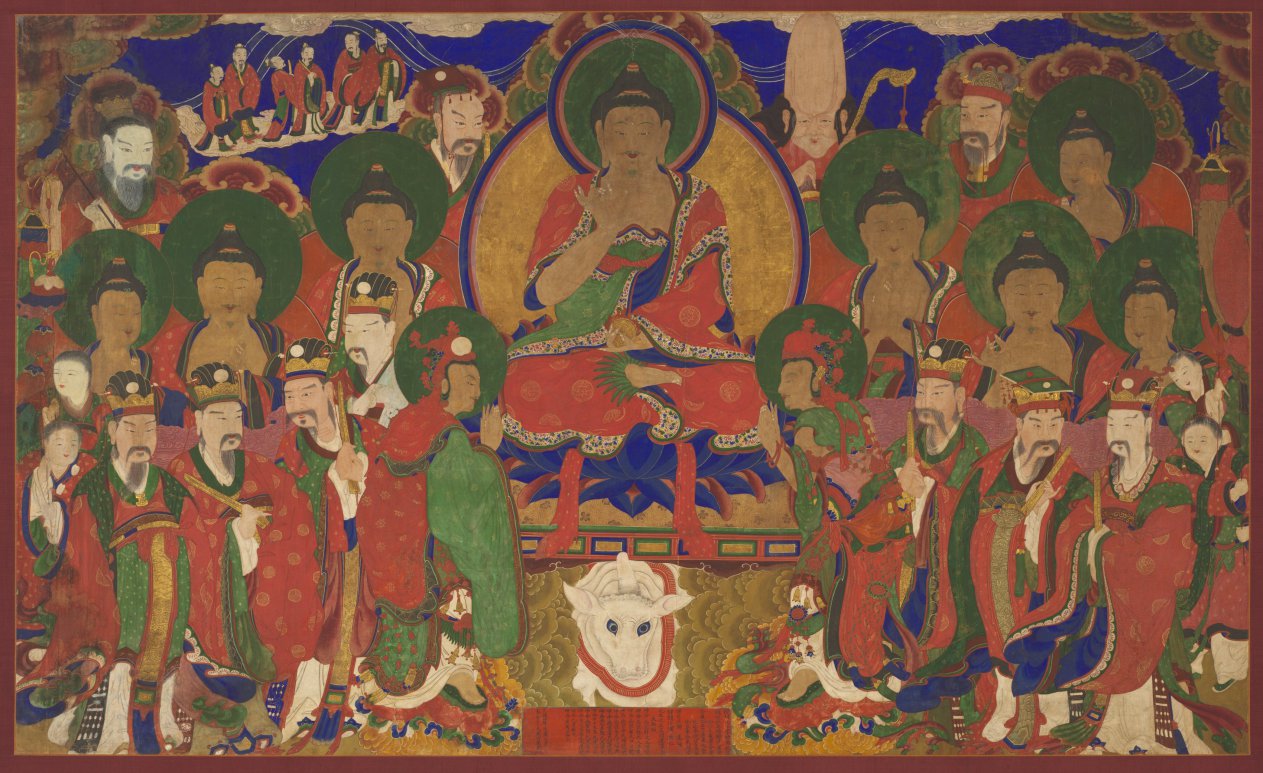
Urban Silhouette Research: The Assembly of Tejaprabha Buddha
I. Structural Poetics: The Geometry of Temporal Arrest
The Assembly of Tejaprabha Buddha presents a definitive case study in the architectural capture of time. The central artifact—the Udumbara Flowers Temple Plaque—is not merely a devotional object but a three-dimensional diagram of suspended animation. Its geometry is defined by a paradoxical tension: the natural grain of the wood (a horizontal, flowing vector) is intersected by the vertical, deliberate incision of the artisan’s chisel. This creates a grid of impermanence, where the organic and the constructed collide. The petals of the Udumbara flower, depicted in a state of partial unfurling, are not rendered as soft curves but as faceted, almost architectural planes. Each cut is a decision, a moment of arrest. The plaque’s silhouette is therefore not a contour but a boundary condition—a line where the flow of time is forcibly halted.
For the 2026 executive silhouette, this translates into a minimalist architecture of the shoulder and sleeve. The Udumbara’s half-opened form dictates a sleeve head that is neither fully relaxed nor aggressively structured. It is a suspended volume—a sleeve that begins as a clean, vertical drop from the shoulder, then subtly expands into a petal-like flare at the wrist, only to be abruptly terminated by a clean, raw edge. This is not a soft gather; it is a geometric incision. The fabric itself must behave like carved wood: a dense, matte wool-cashmere blend in Slate—a color that absorbs light rather than reflecting it, mimicking the patina of aged timber. The grain of the fabric—a subtle herringbone or a tight, vertical twill—echoes the wood’s natural striations, creating a surface that reads as both ancient and rigorously modern.
II. Urban Materiality: The Void as Structural Element
The companion piece, the painting Jar, inverts the plaque’s logic. Where the plaque uses positive form to capture a moment, Jar uses a negative space—the void inside the vessel—as its primary structural element. The jar’s silhouette is a perfect, unbroken ovoid, a closed system. Its power lies not in what it shows, but in what it conceals. The “mouth” of the jar is a threshold, a point of transition between the visible exterior and the invisible interior. This is a critical lesson in urban materiality: the most powerful statement is often the one that is withheld.
In the 2026 executive silhouette, this principle manifests as the internalized volume. The garment is not defined by its outer perimeter but by the space it creates around the body. Consider a coat with a monolithic, seamless front—no buttons, no pockets, no visible closures. The only interruption is a single, precise slit at the neckline or the side seam. This slit is the “mouth of the jar.” It offers a glimpse of the interior—a flash of a contrasting lining in Ivory or a bare collarbone—but never reveals the full contents. The garment becomes a portable void, a private space within the public realm. The fabric must be substantial enough to hold this shape without collapsing: a double-faced wool or a dense, felted cashmere. The color Slate is essential here; it is the color of urban stone, of wet pavement, of the sky before a storm. It is a color that does not compete with the architecture of the city but absorbs it, becoming a part of the built environment.
III. The 2026 Executive Silhouette: A Synthesis of Sacred and Secular
The final silhouette is a synthesis of these two artifacts. It is a Minimalist form that rejects both the exaggerated volume of the Oversized category and the strict adherence to the body of Tailored. Instead, it proposes a third way: a silhouette that is internally structured but externally serene. The key elements are:
- The Shoulder: A clean, slightly extended shoulder line, reminiscent of the plaque’s carved edge. It is not padded but cut with precision, using a raglan or a modified kimono sleeve that allows for a smooth, uninterrupted line from neck to wrist.
- The Torso: A straight, columnar shape that skims the body without clinging. The waist is not defined; the garment falls from the shoulder like a curtain of stone. The length is critical—either cropped at the hip bone or extending to the mid-calf, creating a vertical proportion that elongates the figure.
- The Closure: Invisible. Hidden snaps, magnetic fasteners, or a single, asymmetrical tie at the side. The garment is a sealed vessel, its entry point a secret.
- The Fabric: A dense, matte wool in Slate, with a subtle, irregular texture that mimics the grain of the wooden plaque. The lining, where visible, is a raw silk in Ivory, referencing the unpainted canvas of the Jar painting.
This is not a garment for the impatient. It demands a depth of gaze. The wearer is not displaying status but presence. The silhouette is a meditation on the present moment—a refusal to project meaning into the future (the “three thousand years” of the Udumbara) or into the unseen (the contents of the jar). It is a pure, architectural statement that finds its power in what it withholds. The Assembly of Tejaprabha Buddha teaches us that the ultimate luxury is not accumulation but containment. The 2026 executive silhouette, rendered in Slate, is that containment made wearable. It is a vessel for the self, a plaque for the present, a monument to the now.