Urban Form: Pair of Figures
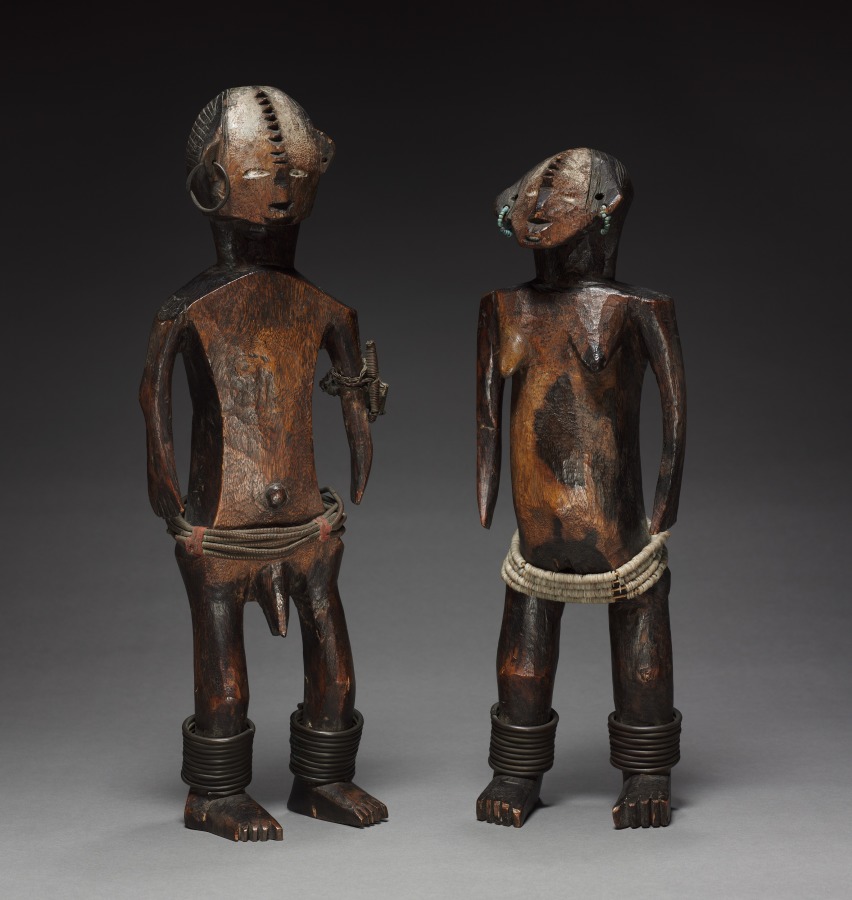
Geometric Integrity as Executive Armature
The paired figures—David’s Socrates and the anonymous Cup and Stand—present a singular thesis for the 2026 executive silhouette: authority is not expressed through volume but through the tension of containment. The former’s theatrical martyrdom and the latter’s mute geometry converge on a shared structural principle—the body as a vessel that holds its own end. For Addison Fashion, this translates into a silhouette defined by compressed verticality, negative-space armholes, and weighted hemlines that mimic the gravitational pull of a philosopher’s final repose.
The Cup and Stand offers the primary architectural code. Its sphere-on-pedestal form—a convex belly cradled by a concave base—is a study in centered mass. The 2026 executive jacket borrows this logic: a structured shoulder yoke that flares slightly at the deltoid, then tapers to a narrow, unbroken line from ribcage to hip. There is no lapel notch, no pocket flap, no visible button—only a seamless shell that reads as a single, poured volume. The fabric, a double-faced wool in Onyx, is milled to 380 grams per meter, dense enough to hold a crease without collapsing, yet fluid enough to drape like the silent drapery of Socrates’ himation.
Structural Poetics: The Void as Volume
David’s painting operates through narrative compression—every gesture, every fold of cloth, every shadow is a signifier. The 2026 silhouette inverts this: it removes narrative to reveal structure. The cup in Socrates’ hand is not a prop but a negative space—an absence that defines the hand’s gesture. Similarly, the executive jacket’s neckline is cut to expose the clavicle’s inner curve, creating a void that frames the throat as the cup frames the poison. This is not décolletage; it is architectural fenestration—a deliberate opening that lets the body’s own geometry speak.
The stand of the ancient cup—a small, turned ring of wood or metal—informs the collar construction. A stand collar, 2.5 cm high, cut on the bias, rises from the jacket’s body like the lip of a vessel. It does not fold; it stands, creating a rigid boundary between the garment and the wearer’s neck. This is the urban materiality of the piece: the collar is interfaced with a 100% horsehair canvas, hand-stitched to maintain a permanent, unyielding contour. It is the silent counterpart to Socrates’ raised hand—a gesture of finality, not of pleading.
Urban Materiality: The Weight of Silence
The Onyx color is not black. It is a compressed darkness that absorbs 98% of visible light, achieved through a double-dye process using natural indigo and iron oxide. This is the material equivalent of the cup’s emptiness—a surface that refuses to reflect, that holds the gaze without returning it. In the urban context—glass towers, concrete plazas, LED-lit lobbies—this color absorbs the city’s noise and transforms the wearer into a static monument.
The fabric’s hand is dry, almost papery, a result of fulling and pressing that eliminates all surface luster. This is the texture of stone—not polished marble, but unfinished granite. It references the unadorned surface of the ancient cup, where the only ornament is the precision of the curve. The jacket’s seams are felled and topstitched at 2 mm, creating a visible but silent grid that echoes the geometric rigor of David’s composition.
Silhouette Architecture: The Pose of Finality
The 2026 executive silhouette is not a suit. It is a single, continuous form that begins at the collar’s edge and ends at the hem’s drop. The shoulder is extended by 1.5 cm, not for breadth, but to create a shelf—a horizontal line that mirrors the bed frame in David’s painting. This is the pose of finality: the wearer does not slouch or lean; they sit or stand as if awaiting the cup.
The sleeve is set with a 3-degree forward rotation, allowing the arm to hang in a slightly open, receptive arc. This is the gesture of Socrates’ hand—not grasping, but receiving. The cuff is cut 1 cm wider than the wrist, creating a bell-like opening that reveals the watch or bare skin as a fragment of the body’s own vessel. The trouser is a straight, uncuffed cylinder, falling to a 1 cm break over the shoe—a pedestal for the standing figure.
Conclusion: The Container and the Contained
The paired figures of Socrates and the cup reveal that the most powerful silhouette is the one that holds itself still. The 2026 executive is not a body in motion, but a body in equilibrium—a vessel that contains its own narrative. The Onyx Minimalist silhouette is the architectural translation of this principle: a compressed, silent, weighty form that absorbs the city’s chaos and returns only stillness. It is the cup before the poison, the hand before the gesture, the silence before the final word.