Minimalist
Onyx
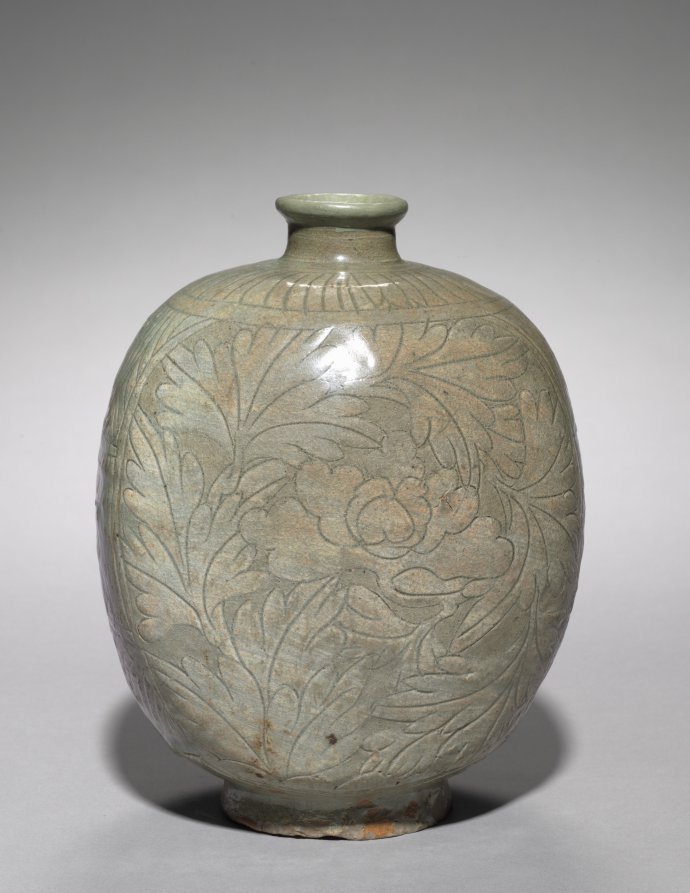
Urban Form: Wine Flask with Incised and Sgraffito Peony Design
Structural Poetics: The Wine Flask as Architectural Volume
The wine flask with incised and sgraffito peony design presents a definitive case study in the translation of two-dimensional ornament into three-dimensional architectural logic. Its form—a compressed, almost cylindrical vessel with a narrow neck and broad shoulder—establishes a primary geometric tension between containment and release. The incised peony motif does not merely decorate the surface; it carves into the volume, creating a series of negative spaces that read as structural seams. Each petal is a line of force, a vector that directs the eye around the circumference, transforming the flask into a rotating architectural elevation. The sgraffito technique, where the top layer of slip is scratched away to reveal a darker clay body beneath, mimics the urban process of excavation—revealing the strata of a city’s history through deliberate, controlled removal. For the 2026 executive silhouette, this translates into garments that are not draped but *excavated*. The shoulder line becomes a sharp, incised arc; the waist is a sgraffito line of negative space, cut away from the body’s volume. The silhouette is a vessel: a minimalist, onyx-black shell that contains the wearer’s presence without yielding to it.Geometric Integrity: The Incised Line as Structural Seam
The peony’s incised lines are not organic curves but calculated arcs, each one a segment of a larger geometric lattice. The flower’s center is a tight, radial spiral—a point of origin from which all petals emanate. This radial geometry is the flask’s hidden armature. It dictates the vessel’s stability, its ability to stand as a self-contained object. In urban materiality, this is the logic of the steel frame: a hidden grid that supports the glass curtain wall. The 2026 executive silhouette must adopt this same hidden armature. The garment’s structure is not in its seams but in its *lines of incision*—the sharp crease of a trouser, the precise cut of a lapel, the deliberate gap between a jacket and a blouse. These are not decorative details; they are load-bearing elements. The peony’s petals, when read as architectural ribs, suggest a silhouette that is rigid at the core and fluid at the edges. The flask’s shoulder, where the neck meets the body, is a moment of pure geometric transition—a 90-degree shift from vertical to horizontal. This is the executive shoulder: a clean, unbroken line that defines the upper torso as a structural platform.Urban Materiality: Onyx and the Aesthetics of Excavation
The color Onyx is not a passive choice. It is the color of the excavated void, of the deep urban core where light is absorbed rather than reflected. The wine flask’s dark clay body, revealed through the sgraffito, is the urban ground—the asphalt, the granite, the basalt. The incised peony, in its lighter slip, is the ghost of the natural world, a memory of growth that has been carved into the city’s skin. For the 2026 silhouette, Onyx is the primary material language. It is the color of the executive’s armor: a matte, light-absorbing surface that refuses to perform. The garment’s texture must mimic the flask’s surface—a smooth, polished exterior that yields to a rough, incised interior. This is urban materiality at its most sophisticated: the jacket’s exterior is a seamless, onyx shell; the lining, revealed only at the collar or cuff, is a sgraffito pattern of incised lines, a hidden map of the city’s grid. The peony’s petals, when translated into fabric, become structural pleats—sharp, architectural folds that hold their shape without draping. These pleats are not soft; they are *carved*. They stand away from the body, creating a volume of air between the garment and the skin. This is the executive silhouette as urban artifact: a piece of the city’s built environment, worn on the body.The Sgraffito Principle: Layered Time in Garment Construction
The sgraffito technique is a metaphor for the 2026 executive wardrobe. It is not about adding layers but about *removing* them to reveal what lies beneath. The wine flask’s peony is not painted on; it is scratched out. The design exists as a negative space, a void that defines the positive form. In garment construction, this translates to a silhouette that is built through subtraction. The jacket is not assembled from panels; it is carved from a single volume. The sleeves are not attached; they are incised from the body. The waist is not cinched; it is excavated. This is the poetics of the minimalist executive: the garment is a solid block of onyx-colored material, and the design is the act of cutting away everything that is not essential. The peony’s radial geometry becomes the garment’s pattern—a series of incised lines that create the armholes, the neckline, the hem. Each cut is a decision, a mark of intention. The urban executive wears this sgraffito logic as a statement of control: the body is the vessel, and the garment is the excavation.The Void as Volume: Negative Space in the Executive Silhouette
The wine flask’s most powerful architectural feature is its interior void. The vessel contains nothing but potential—the space where liquid will be held. This void is the true volume of the object. In the 2026 executive silhouette, the void is the space between the garment and the body. The onyx shell does not cling; it hovers. The shoulder line is a cantilever, projecting outward to create a void of air beneath. The peony’s incised petals are not just surface decoration; they are windows into this void. The garment’s cutouts—at the shoulder, the waist, the back—are not erotic gestures but architectural openings. They reveal the body as the vessel’s interior, the hidden volume that gives the silhouette its purpose. This is the urban poetics of the minimalist executive: the body is not displayed but *contained*. The garment is a structure that holds the body in a state of suspended animation, a wine flask waiting to be filled with the executive’s presence.Conclusion: The 2026 Executive as Urban Vessel
The wine flask with incised and sgraffito peony design is not a decorative object but a structural manifesto. Its geometric integrity—the radial lattice, the incised seams, the excavated void—defines the 2026 executive silhouette as a study in controlled volume and urban materiality. The color Onyx grounds this silhouette in the city’s deep geology, while the sgraffito principle of layered removal creates a garment that is built through subtraction. The executive wears not a suit but a vessel: a minimalist, onyx-black shell that contains the body as the flask contains the wine. The peony’s petals, incised into the surface, are the only ornament—a reminder that even in the most austere urban landscape, there is a memory of growth, a line of force that connects the executive to the natural world. This is the definitive urban silhouette for 2026: a structure of pure intention, carved from the city’s own material.
Technical Insight
Technical Insight: Translating Onyx palettes into Minimalist silhouettes for the modern metropolis.