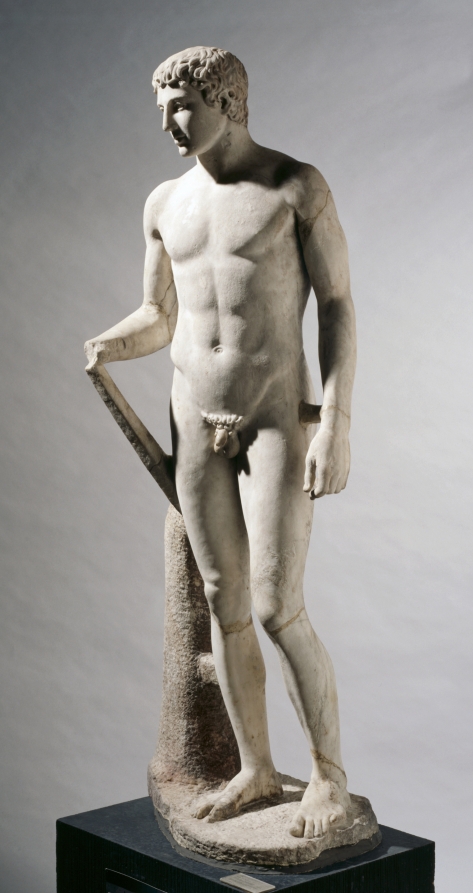
Urban Form: Statue of an Athlete
Executive Summary: The Dialectic of Vessel and Void
This Urban Silhouette Research for Addison Fashion NYC deconstructs the formal and chromatic DNA of two disparate artifacts—the Neolithic Chinese Jar (Hu) and Jacques-Louis David’s neoclassical masterpiece, The Death of Socrates. The objective is to distill a coherent, market-ready design language for the 2026 executive wardrobe, one that reconciles Eastern material humility with Western rationalist structure. The resulting silhouette is a study in Minimalist rigor, anchored by the color Onyx—a hue that absorbs light, denies ornament, and functions as a chromatic void. This analysis proceeds through three vectors: volumetric form, surface tension, and the poetics of emptiness.
I. Volumetric Architecture: The Jar and the Frame
A. The Jar (Hu): Gravitas Through Compression
The Jar (Hu) presents a primary form of spherical expansion—a full, rounded belly that suggests containment and fecundity. Its silhouette is defined by a low center of gravity, with a broad base tapering to a narrow, constricted neck. This is not a form that reaches upward; it settles. For the 2026 executive, this translates into a dropped shoulder, extended torso construction. The jacket should avoid sharp lapels or aggressive padding. Instead, the shoulder seam falls naturally, creating a continuous line from neck to hem. The waist is suggested, not cinched—a subtle inward curve that mimics the jar’s transition from belly to neck. The result is a silhouette that occupies space without claiming it, a quiet assertion of presence.
The jar’s foot—a stable, circular base—informs the trouser cut. A wide-leg, high-waisted trouser with a slight taper at the ankle mirrors the jar’s grounding. The fabric should fall with a dense, unbroken weight, avoiding any break at the shoe. This creates a visual anchor, a column of Onyx that extends from the waist to the floor. The hem should be clean, unhemmed, or raw-edged to echo the jar’s unpolished rim.
B. The Death of Socrates: The Geometry of Rationality
David’s composition is a masterclass in triangulation and axial alignment. Socrates’s outstretched arm forms a diagonal, his seated body a pyramid, the surrounding disciples a series of interlocking triangles. This is not organic; it is engineered. The 2026 executive wardrobe must adopt this structural clarity. The jacket’s internal construction should feature a canvas chest piece that maintains a rigid, unyielding front. The back panel, however, should be cut with a single, continuous seam from shoulder to hem—a nod to the jar’s monolithic form. The result is a garment that feels armored yet fluid, a paradox of soft tailoring and hard geometry.
The collar is critical. David’s painting uses the white of Socrates’s robe as a focal point against the dark background. In our palette, the collar of an Onyx jacket should be cut in a sharp, notched lapel—but rendered in a matte, almost chalky finish. This creates a subtle contrast, a “white” within the black, without introducing a second color. The lapel’s width should be 3.5 inches, a deliberate proportion that references the classical orders of architecture. It is neither too narrow (fashionable) nor too wide (dated), but eternal.
II. Surface Tension: Texture as Narrative
A. The Jar’s Patina: Imperfection as Luxury
The Jar (Hu) is not smooth. Its surface bears the marks of its making—fingerprints, uneven glazing, the subtle undulation of hand-coiled clay. This is tactile honesty. For the 2026 wardrobe, this translates into a rejection of high-shine, synthetic finishes. The Onyx fabric should be a wool-cashmere blend with a slight slub or irregular weave. A flannel finish is ideal: matte, slightly napped, with a soft, dusty hand. This surface absorbs light rather than reflecting it, creating a depth that shifts with movement. The garment should feel heavy but not stiff, like a well-worn stone.
Seams should be felled or flat-felled, visible but not decorative. They are the “cracks” in the jar’s surface—marks of construction that become part of the aesthetic. Pockets should be welted, flush with the fabric, never protruding. The goal is a garment that reads as a single, continuous surface, broken only by the necessary lines of tailoring.
B. David’s Light: The Drama of Contrast
David’s painting uses chiaroscuro to define form. Light falls on Socrates’s torso, his hand, the cup. The rest is shadow. In the 2026 wardrobe, this translates into strategic opacity. The Onyx fabric should be double-faced or reversible—one side matte, one side with a subtle sheen. This allows the wearer to create their own light and shadow through layering. A jacket with a matte exterior and a slightly lustrous interior lining, when unbuttoned, reveals a flash of light against the dark. This is not decoration; it is architectural lighting applied to the body.
The absence of color is itself a color. Onyx is not black; it is a compressed darkness that contains all hues within it. The fabric should be dyed using a natural indigo or carbon-based pigment, resulting in a depth that synthetic blacks cannot achieve. Under direct light, the fabric should appear almost blue-black; in shadow, it becomes a void. This chromatic instability is the urban equivalent of the jar’s patina—a surface that changes with the viewer’s angle and the light’s quality.
III. The Poetics of Emptiness: Void as Design Principle
A. The Jar’s Interior: The Unseen Volume
The Jar (Hu) is defined by what it contains: nothing, until filled. Its form is a shell around a void. The 2026 executive wardrobe must incorporate this principle through negative space. The jacket should be cut with a generous armhole, allowing the sleeve to hang away from the body. The back should have a center vent that opens slightly when the wearer moves, revealing the lining—a glimpse of the “inside.” The trouser should have a high rise that creates a pocket of air between the fabric and the waist. These are not functional details; they are philosophical gestures toward the emptiness that makes form meaningful.
The absence of closure is another void. The jacket should be designed to be worn unbuttoned, the lapels falling open to reveal the shirt or bare skin. This is the equivalent of the jar’s open mouth—an invitation, a readiness to receive. The shirt beneath should be a simple, high-neck shell in the same Onyx tone, creating a continuous field of darkness. The only break is the collar’s edge, a thin line of contrast.
B. Socrates’s Cup: The Void as Threshold
In David’s painting, the cup of hemlock is the object of transformation. It is a vessel that contains death, but also transcendence. For the 2026 wardrobe, the pocket square or lapel pin becomes this cup—a small, deliberate object that carries symbolic weight. It should be geometric, not floral: a square of raw silk in a slightly lighter Onyx, folded into a perfect rectangle. It is not decorative; it is ritualistic. The act of placing it in the pocket is a meditation on the day’s end, a reminder that every garment is a container for the self.
The absence of branding is the final void. No logos, no labels, no visible markers of origin. The garment speaks through its form alone. This is the ultimate luxury—a silence that invites the wearer to project their own meaning onto the object. Like the jar, it does not explain itself. Like the painting, it frames a moment of profound significance. The 2026 Addison Fashion executive wardrobe is not a collection of clothes; it is a series of vessels, each designed to hold the weight of a life lived in the city.
Conclusion: The Onyx Silhouette as Urban Armor
The synthesis of the Jar (Hu) and The Death of Socrates yields a wardrobe that is minimalist in form, maximalist in meaning. The Onyx color is not a choice; it is a consequence of the design philosophy—a darkness that contains all light, a void that invites filling. The silhouette is grounded, geometric, and tactile, a response to the chaos of urban life through the discipline of form. This is not fashion for the sake of novelty. It is functional philosophy, a daily practice of wearing one’s values. The 2026 executive who wears this silhouette does not merely dress; they inhabit a structure that has been refined through millennia of human thought about what it means to contain, to hold, and to let go.