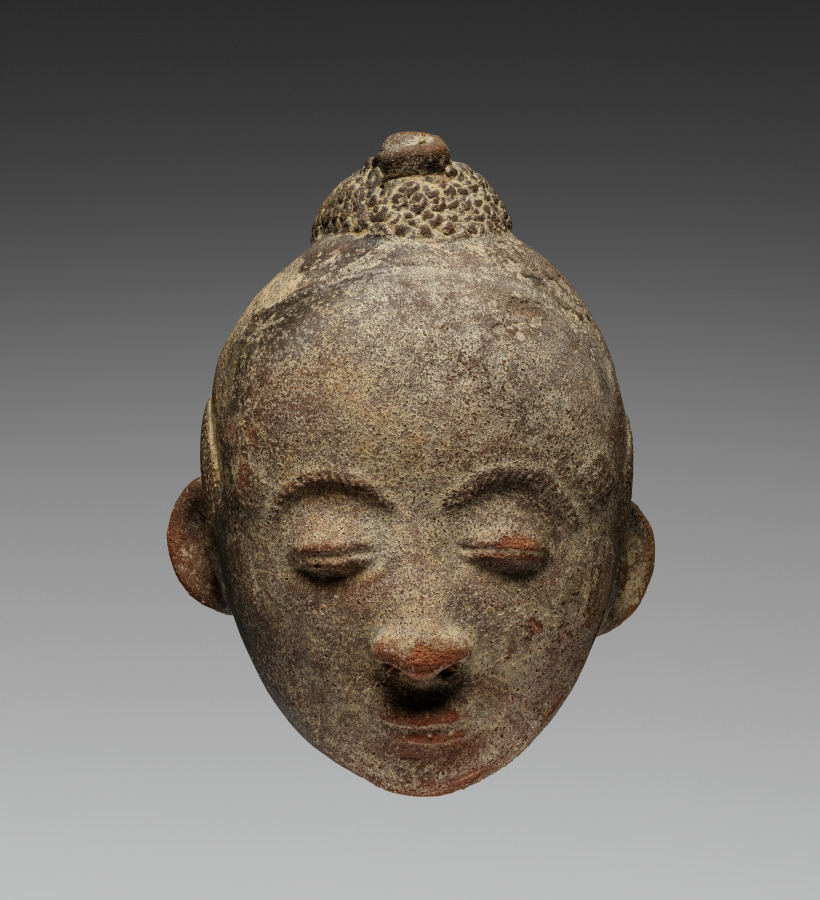
Urban Form: Memorial head (nsodie)
Executive Summary: The Dialectic of Terminal Form
This Urban Silhouette Research for Addison Fashion NYC deconstructs the aesthetic dialogue between two monumental artifacts: the vessel The Death of Socrates (Greek ceramic tradition) and the stele Stele with Sakyamuni and Bodhisattvas (Indian stone relief with mineral pigment). Both artifacts confront the terminal condition—mortality and enlightenment—through distinct formal languages. For the 2026 executive wardrobe, these ancient precedents offer a rigorous framework for resolving the tension between heroic individual will and transcendent dissolution of self. The resulting silhouette is a minimalist synthesis: a cold, urban poetics that leverages geometric precision and chromatic restraint to articulate power, presence, and the quiet authority of finality.
I. Formal Analysis: The Geometry of Finality
A. The Socratic Silhouette: Rational Line and Heroic Stasis
The Greek vessel depicting Socrates’ death operates through geometric reduction. The philosopher’s form is rendered with clean, unbroken contours—a vertical axis of dignity against the horizontal plane of the cup. The line is taut, deliberate, and unyielding. The hand pointing upward is not a gesture of desperation but a vector toward the ideal realm. This is a silhouette of resistance: the body as a container for rational will, its boundaries sharply defined against negative space. The dark, matte surface absorbs light, creating a monolithic presence that refuses sentimentality. For the 2026 wardrobe, this translates into a structured, architectural shoulder—a jacket or coat that frames the torso as a fixed volume. The line from shoulder to hem must be uninterrupted, a single, decisive stroke. The Onyx color choice mirrors the vessel’s dark, absorbing surface, projecting impenetrable composure.
B. The Sakyamuni Silhouette: Fluid Drape and Dissolving Boundary
In contrast, the Indian stele employs undulating, water-like lines for the robes of the Buddha and bodhisattvas. The form is not a container but a field of flow. The mineral pigments—cinnabar, lapis lazuli, orpiment—create a layered, luminous surface that denies fixed edges. The Buddha’s reclining posture is a horizontal dissolution; the body merges with the ground, the robes cascade without resistance. This is a silhouette of surrender—not weakness, but the ultimate strength of non-attachment. The formal language is organic, repetitive, and rhythmic, suggesting infinite continuity. For the executive wardrobe, this informs the fluid pant or the asymmetrical drape in a top or outer layer. The fabric must fall with controlled weight, creating soft folds that absorb rather than reflect the body’s structure. The Onyx palette here shifts from matte to a subtle, mineral sheen—a nod to the ancient pigments’ enduring luminosity.
II. Chromatic Strategy: The Onyx Spectrum
A. The Rational Black: Absorbing Light, Defining Edge
The Onyx color family for this collection operates on two registers. The first is absolute matte black, referencing the Greek vessel’s dark slip. This black is non-reflective, a void that defines form through absence. It is the color of finality and decision. In a tailored jacket, this black creates a sharp, unforgiving silhouette—ideal for the executive who commands space through stillness. The second register is deep charcoal with mineral undertones, echoing the Indian stele’s weathered stone. This black is alive with texture—a subtle grain or weave that catches light at oblique angles. It suggests depth without distraction, a surface that rewards close inspection. This duality allows the wardrobe to shift between heroic assertion (matte) and contemplative absorption (textured).
B. The Chromatic Accent: Mineral Memory
While the primary palette is Onyx, the research permits a single accent derived from the stele’s mineral pigments: a desaturated cinnabar (burnt red) or faded lapis (dusty blue). These are not vibrant; they are weathered, archival tones that appear as if excavated. The accent is deployed sparingly—a lining, a stitch, a single panel—to suggest the memory of color without disrupting the minimalist monochrome. This is not decoration; it is a formal citation of the ancient dialogue between stone and pigment, between permanence and decay.
III. The 2026 Executive Silhouette: Synthesis and Application
A. The Heroic Jacket: Socratic Structure
The cornerstone is a single-breasted, notched-lapel jacket in matte Onyx wool. The shoulder is extended and squared, referencing the Greek vessel’s geometric precision. The waist is suppressed but not cinched—a subtle hourglass that suggests controlled power. The length extends to the mid-thigh, creating a vertical block that elongates the torso. The lapel is wide and straight, a horizontal counterpoint to the vertical line. This jacket is the armor of rational will, a garment that declares the wearer’s presence as a fixed point in a fluid world.
B. The Fluid Pant: Sakyamuni Flow
Paired with the jacket is a wide-leg, high-waist trouser in textured Onyx crepe. The fabric is heavy with drape, falling in soft, continuous folds from waist to hem. The leg is voluminous but not baggy; the silhouette is columnar with a gentle break at the shoe. This pant absorbs movement, creating a silent, flowing line that contrasts with the jacket’s rigidity. It is the horizontal dissolution of the Buddha’s robe, translated into urban motion. The combination of structured top and fluid bottom creates a dialectic of resistance and surrender—the executive who can both command and release.
C. The Terminal Accessory: The Mineral Stitch
A single accessory completes the ensemble: a silk scarf or pocket square in faded cinnabar, hand-stitched with a geometric motif derived from the Greek vessel’s line. The motif is abstract—a single upward vector or a horizontal band—not representational. This is the chromatic and formal echo of the ancient dialogue, a reminder that the wardrobe is not merely clothing but a philosophical instrument for navigating the terminal conditions of urban life: deadlines, decisions, and the quiet dissolution of the self into the collective.
IV. Conclusion: The Aesthetics of Finality
The Minimalist category and Onyx palette are not arbitrary choices. They are the formal resolution of the Socratic and Sakyamuni dialectic. The Greek vessel teaches us that form can resist time through precision and boundary. The Indian stele teaches us that form can transcend time through flow and dissolution. The 2026 executive wardrobe must hold both truths simultaneously. The structured jacket is the heroic gesture; the fluid pant is the contemplative release. The Onyx palette is the void that contains all possibility. This is not fashion as ornament. This is wardrobe as philosophy—a cold, urban poetics for the executive who understands that every silhouette is a statement about how we face the end.