Urban Form: Courtyard, Alhambra
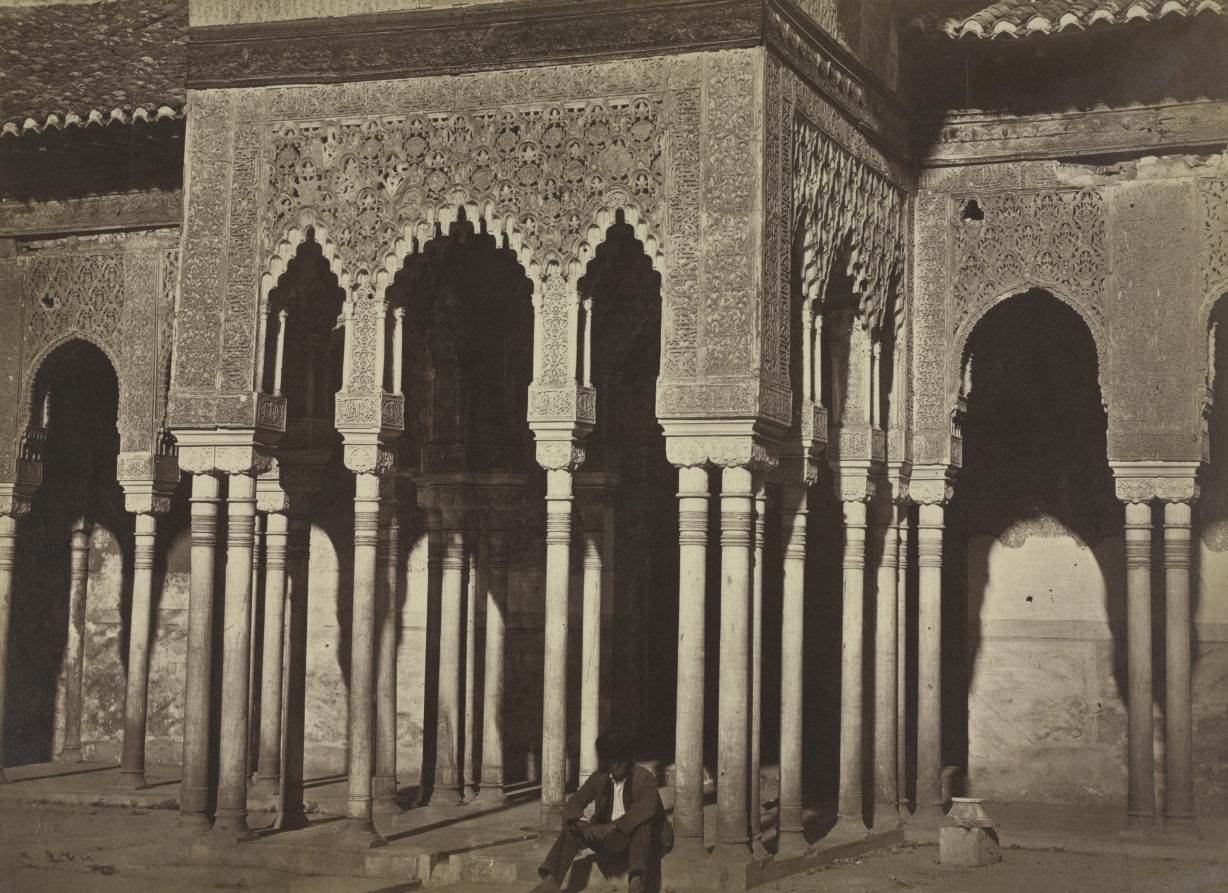
Geometric Integrity: The Alhambra Courtyard as a Spatial Paradigm
The Alhambra Courtyard, in its distilled architectural essence, is not a space of ornament but a study in negative volume. Its geometric integrity is defined by the precise articulation of void—the courtyard as a carved-out interior, a negative solid that exists in perfect tension with the enclosing walls. For the 2026 executive silhouette, this principle translates into a garment that is not draped over the body but carved around it. The silhouette must read as a series of planar intersections: a sharp shoulder line that mirrors the courtyard’s arcade, a clean vertical drop that echoes the reflecting pool’s edge, and a hem that terminates with the finality of a stone plinth. The geometry is subtractive: every seam is a cut, every dart a removal of excess, leaving only the essential architectural shell.
The courtyard’s modular repetition of columns and arches provides a rhythmic structure. In the garment, this is replicated through a systematic approach to paneling. A jacket, for instance, would feature a front panel that is a single, unbroken plane of Onyx wool—a color that absorbs light and flattens volume—bisected only by a vertical seam that runs from the collarbone to the hem, mimicking the column’s axiality. The back panel, conversely, is a study in negative space: a deep, sharp cutaway that exposes the shoulder blades, creating a void where fabric should be. This is the architectural poetics of the Alhambra—the space between the columns is as important as the columns themselves. The garment’s volume is not inflated but contained, held within strict geometric boundaries that refuse to yield to the body’s natural curves.
Structural Poetics: From Udumbara to Fangyou
The internal DNA of the Addison collection—the Udumbara Flowers temple plaque and the Square Wine Container (Fangyou)—offers a dialectical framework for this silhouette. The plaque’s aesthetic of “borrowing” (借) informs the garment’s relationship with the body. The fabric does not describe the body; it borrows the body’s structure to create its own architectural form. The Onyx wool is a surface that, like the wooden plaque, is both material and symbolic. Its texture is not decorative but tectonic: a subtle herringbone weave that, under direct light, reveals a pattern as precise as the plaque’s carved petals. This is not a floral motif; it is a structural echo—a visual rhythm that suggests the flower’s geometry without representing it.
The Fangyou’s principle of “concealment” (藏) governs the garment’s interior engineering. The bronze vessel’s strength lies in its hidden complexity—the thick walls that support the surface decoration, the precise casting that allows the form to stand. In the 2026 executive silhouette, this translates to invisible structure. The jacket’s shoulders are reinforced with a hidden canvas that is cut and shaped to the exact angle of the Alhambra’s architrave. The sleeves are set with a negative ease that forces the arm into a specific, controlled posture—the posture of a figure standing in a courtyard, arms slightly away from the body, creating a defined silhouette against the stone. The garment’s weight is not distributed but concentrated at key structural points: the shoulder seam, the center back, the hem. This is the urban materiality of bronze—a heaviness that is not cumbersome but authoritative.
Urban Materiality: Onyx and the Executive Surface
Onyx, as the chosen color, is not a shade but a material condition. It is the color of polished stone, of deep water in shadow, of the Alhambra’s reflecting pools at dusk. In the urban context, Onyx reads as absolute authority—a surface that absorbs all light and returns nothing, creating a figure that is both present and impenetrable. The fabric must be a dense worsted wool with a matte finish, its surface as smooth and unyielding as the courtyard’s marble. Any sheen would break the geometric integrity; the garment must exist as a monolithic block of color, its only variation coming from the play of light across its planar surfaces.
The urban materiality of this silhouette is defined by its resistance to the environment. The Alhambra courtyard is a space of controlled climate—a microcosm within the city. Similarly, the executive garment is a mobile enclosure, a portable architecture that shields the wearer from the chaos of the urban landscape. The fabric’s weight (450 gsm) and its tight weave create a wind-resistant barrier, while the silhouette’s sharp angles deflect rain and debris. The garment is not meant to blend with the city; it is meant to stand against it, a geometric statement of intent. The pockets are not functional but architectural—set at a precise 15-degree angle, they echo the courtyard’s water channels, guiding the eye along the garment’s horizontal axis.
The 2026 Executive Silhouette: A Synthesis
The definitive silhouette for 2026 is a Minimalist architectural shell in Onyx. It is a garment that rejects the fluidity of the previous decade in favor of a rigid, structural poetics. The jacket is a single-breasted, notch-less design with a straight, dropped shoulder that creates a horizontal line from neck to arm, mimicking the courtyard’s arcade. The body is slightly A-line, widening from the chest to the hem, creating a trapezoidal volume that is both stable and dynamic. The trousers are a straight, wide-leg cut, with a front crease that is pressed so sharply it becomes a geometric incision. The waist is high, the rise long, creating a continuous vertical line from shoulder to floor. The entire ensemble is a study in controlled volume—the body is not revealed but enclosed, a figure moving through the city as a piece of architecture.
This is the urban silhouette of the executive who understands that power is not expressed through excess but through restraint. The garment’s beauty lies in its negative space, in the voids it creates around the body, in the precision of its lines. It is a silhouette that borrows from the Alhambra’s courtyard the lesson that the most profound geometry is the one that defines what is not there. The 2026 executive does not wear clothing; they inhabit a portable structure—a garment that is as much a statement of spatial philosophy as it is a piece of urban armor.