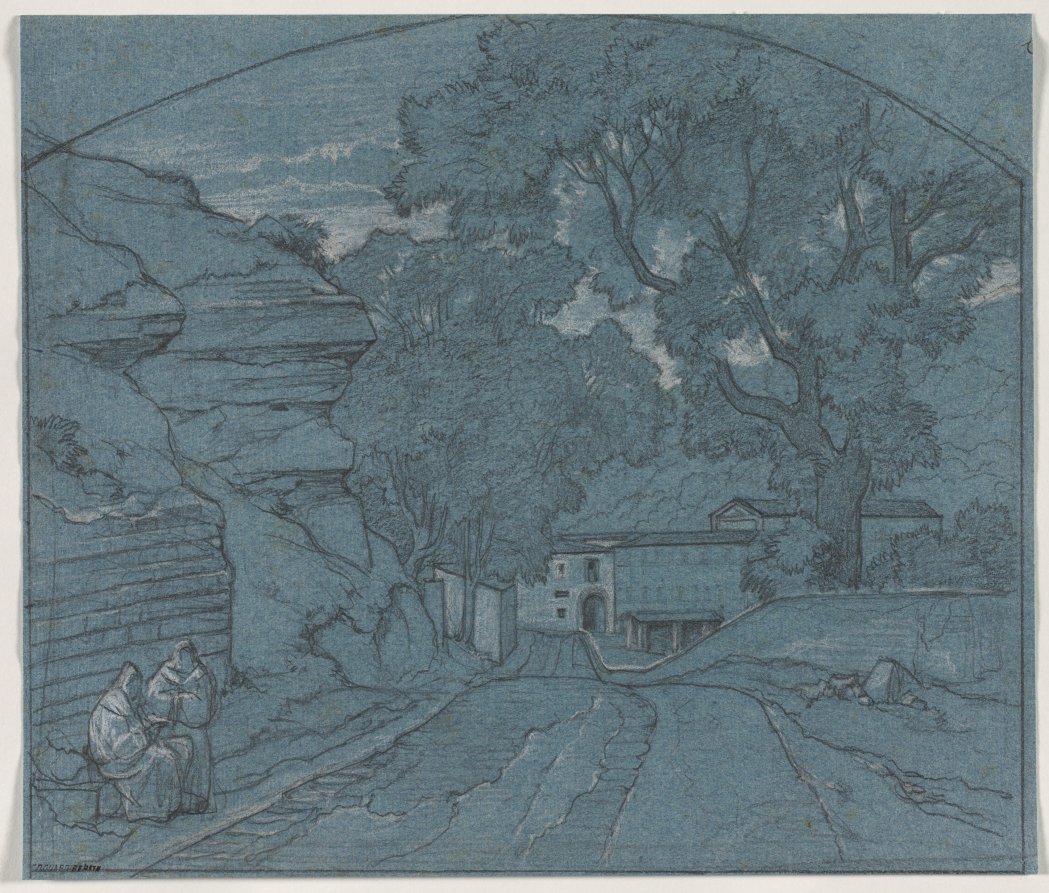
Urban Form: Landscape with Two Monks
Geometric Integrity and the Architecture of Threshold
The dialogue between The Agony in the Garden and Below, I Saw the Vaporous Contours of a Human Form provides a definitive framework for the 2026 executive silhouette. The former operates within a system of compressed, tectonic geometry—the kneeling figure of Christ is a study in angular torsion, a mass of draped fabric that reads as a series of intersecting planes. The latter, by contrast, proposes a geometry of dissolution, where the human form becomes a series of implied vectors, a negative space defined by its own absence. For Addison Fashion, the synthesis is not a compromise but a dialectical resolution: the silhouette must possess the structural clarity of a Renaissance altarpiece while accommodating the atmospheric permeability of a modern apparition.
The 2026 executive silhouette is therefore defined by minimalist rigor—a reduction to essential lines that do not merely clothe the body but construct a spatial argument. The shoulder line, traditionally a locus of power, is here treated as a cantilevered plane, sharp and unyielding, referencing the geological strata of the Garden’s rocky foreground. Yet this hardness is immediately counterpointed by the vaporous contour of the hemline and sleeve openings, which are cut with a deliberate asymmetry that suggests a form in the process of becoming or un-becoming. The silhouette is not static; it is a threshold state between presence and absence, between the solidity of the sacred body and the evanescence of the spectral outline.
Structural Poetics: From Tectonic Compression to Atmospheric Release
The structural poetics of this research are grounded in the concept of “negative tension.” In The Agony in the Garden, tension is created through the compression of mass—the heavy drapery of the sleeping disciples, the angular folds of Christ’s robe, the rigid verticals of the distant city walls. These elements create a visual gravity that pulls the eye downward, anchoring the spiritual crisis in the physical world. For the 2026 silhouette, this translates into a high, structured collar that acts as a fulcrum, and a double-layered bodice where the outer shell is cut with severe, architectural seams that mimic the fractured planes of a rock face. The interior layer, however, is cut from a fluid, matte jersey that drapes with a liquid weight, creating a dialogue between rigidity and flow.
Conversely, Below, I Saw the Vaporous Contours inverts this tension. The “vaporous” quality demands a release of structure—a silhouette that dissipates at its extremities. This is achieved through the use of unlined, bias-cut panels that fall away from the body, creating a negative silhouette that is defined as much by the air around it as by the fabric itself. The sleeve becomes a critical site of this poetics: it is cut with a deep, angular gusset that allows the fabric to float away from the arm, creating a vaporous halo of shadow and light. The hem is raw-edged and weighted with a micro-chain, so that it moves with a slow, gravitational drift, echoing the “steam-like” quality of the modern work. The result is a garment that is both a fortress and a phantom—a structure that contains its own dissolution.
Urban Materiality: Onyx, Silver, and the Texture of the Sacred
The material palette for this silhouette is dictated by the chromatic and tactile extremes of the two artworks. Onyx is the foundational color—a black so deep it absorbs light, referencing the pre-dawn darkness of the Garden and the void-like background of the vaporous form. This is not a flat black; it is a textured, reactive surface achieved through a double-faced wool crepe with a subtle, irregular weave that catches light like dry stone. Against this, Silver appears not as a color but as a metallic ghost—a liquid silver lamé used for the interior lining and the bias-cut panels, visible only in movement, like a flash of a halo or the glint of a distant spear.
The urban materiality is further defined by tactile contrasts that mirror the theological tension between the two works. The primary fabric, a heavy, compacted wool, is treated with a nano-ceramic finish that gives it a slick, almost mineral surface—a material that feels cold and ancient, like the stone of a Renaissance city. This is juxtaposed with panels of micro-perforated leather in the same Onyx shade, which create a vaporous pattern of tiny holes, allowing the Silver lining to glimmer through like a constellation of distant stars. The seams are not hidden; they are exposed and stitched with a metallic thread, becoming architectural lines that map the garment’s structural logic. This is a materiality that speaks to the urban executive—a being who moves between the concrete and the ethereal, the boardroom and the gallery, the visible and the unseen.
The 2026 Executive Silhouette: A Manifesto of Controlled Dissolution
In conclusion, the 2026 executive silhouette from Addison Fashion is a minimalist manifesto of controlled dissolution. It rejects the soft, amorphous shapes of recent seasons in favor of a rigorous, almost architectural geometry that is then deliberately destabilized. The jacket is the key garment: a single-breasted, elongated form with a sharp, notched lapel that extends into a dramatic, asymmetrical point, referencing the angularity of a Gothic spire. The shoulder is structured but not padded, achieved through a complex pattern of darts and seams that create a sculptural volume without bulk. The trousers are high-waisted and wide-legged, cut with a single, sharp crease that falls from the hip to the hem, but the fabric is weighted with a liquid drape that allows the leg to disappear into a pool of shadow at the floor.
This silhouette is not for the faint of spirit. It demands a posture of authority that is both grounded and transcendent. It is the uniform for the executive who understands that power is not about presence alone, but about the mastery of absence—the ability to be both solid and vaporous, to command a room while remaining partially invisible. The Onyx and Silver palette reinforces this duality: the darkness is a void of potential, the silver a flash of revelation. The 2026 Addison Fashion executive does not merely wear clothes; she inhabits a threshold between the agony of the concrete and the ecstasy of the ephemeral. She is, in essence, a landscape with two monks—a figure of severe grace and vaporous authority.