Urban Form: Gorget (Rei Miro)
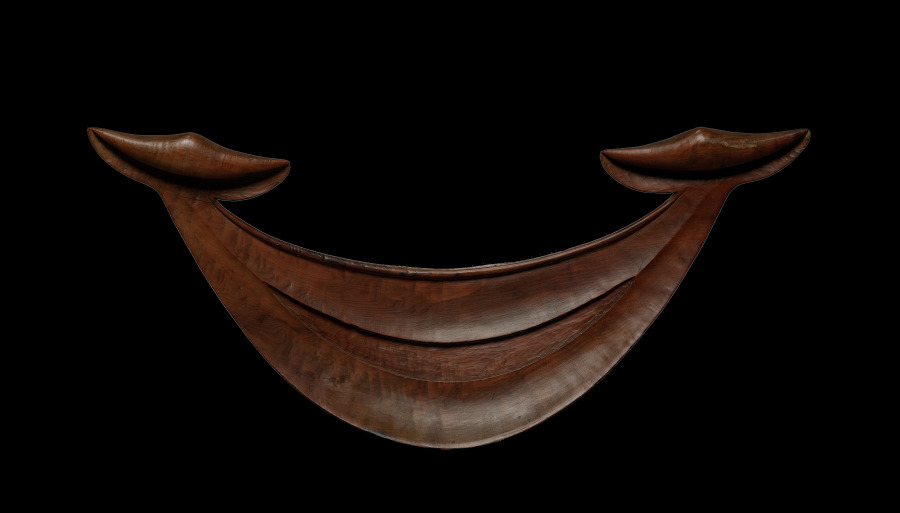
Structural Poetics: The Gorget as a Threshold Object
The Rei Miro, or gorget, is not merely an accessory; it is a tectonic proposition. In the context of the 2026 executive silhouette, this crescent-shaped pectoral artifact functions as a geometric anchor—a rigid, horizontal counterpoint to the vertical flow of a tailored suit or a fluid dress. Its form, a perfect arc of negative space, embodies the minimalist luxury that defines Addison Fashion’s urban poetics. The gorget does not adorn the body; it frames it, creating a deliberate void between the clavicle and the sternum, a void that speaks to the tension between presence and absence, between the solid and the vaporous.
Drawing from the internal DNA of the two artworks cited—The Agony in the Garden and Below, I Saw the Vaporous Contours of a Human Form—the gorget becomes a threshold object. In the former, the agony is rendered with concrete, anatomical precision; the gorget, in its Onyx finish, echoes this density. It is a solid, polished mass that sits on the chest like a piece of architectural armor, a mineralized fragment of the sacred drama. In the latter, the vaporous contours suggest dissolution; the gorget’s crescent shape, however, is a boundary—a sharp, decisive line that prevents the silhouette from dissolving into the ambient space. It is the visible edge of an otherwise invisible presence.
Geometric Integrity: The Arc and the Void
The geometric integrity of the gorget lies in its pure, unbroken arc. This is not a decorative curve; it is a structural statement. The arc mimics the collarbone’s natural sweep but exaggerates it, creating a hyperbolic extension that widens the shoulders and narrows the waist. This is the architectural silhouette of the 2026 executive: a form that is both protective and revealing. The gorget’s interior void—the space between the metal and the skin—is the critical negative space. It is here that the garment’s urban materiality is most potent. The void is not empty; it is charged with the energy of the unseen, the “vaporous contours” of the human form that the second artwork evokes.
In terms of structural poetics, the gorget operates as a cantilevered plane. It projects outward from the sternum, defying gravity, and in doing so, it redefines the neckline. The traditional V-neck or crewneck is replaced by a horizontal chasm, a deliberate break in the vertical line. This break is the critical moment—the “agony” of the first artwork, where the body is both exposed and protected. The gorget’s polished Onyx surface reflects the urban environment, absorbing and refracting the city’s light, making the wearer a mobile sculpture within the architectural landscape.
Urban Materiality: Onyx and the Executive Silhouette
The choice of Onyx is not arbitrary. This material, with its deep, opaque blackness and subtle striations, embodies the minimalist luxury of the 2026 executive. Onyx is a sedimentary stone, formed under pressure over millennia. It carries the weight of time and the memory of compression. In the urban context, it speaks to the density of the city—the stacked layers of concrete, glass, and steel. The gorget in Onyx is a fossilized fragment of this urban geology, a wearable artifact that connects the executive to the city’s deep structure.
The materiality of the gorget also engages with the tactile and the visual. Its surface is cold, smooth, and reflective, yet it retains a matte finish that prevents it from being garish. This is not the high-gloss of a luxury car; it is the subdued sheen of a polished stone, a quiet authority. The gorget does not shout; it resonates. Its weight on the chest is a constant reminder of the body’s presence, a grounding force in the chaos of the urban environment. This is the executive silhouette as a fortress—a form that is both impenetrable and elegant.
The 2026 Silhouette: A Synthesis of Solid and Vapor
The 2026 executive silhouette, as defined by the gorget, is a synthesis of the two artworks’ opposing aesthetics. From The Agony in the Garden, it borrows the concrete, sculptural weight of the body in crisis. The gorget is the armor of the modern martyr, the executive who bears the weight of the corporate world. From Below, I Saw the Vaporous Contours, it borrows the ambiguity of the threshold. The gorget’s void is the space of potential, the “vaporous contours” of the self that are never fully revealed. The silhouette is thus a dialectic between the solid and the ethereal, the permanent and the transient.
In practical terms, the gorget is worn with a high-necked, tailored jacket that extends the vertical line of the body. The jacket is slim, structured, and devoid of lapels, allowing the gorget to be the sole focal point. The trousers are straight-cut and fluid, falling to the floor with a minimal break. The overall effect is one of controlled tension: the upper body is armored, the lower body is fluid. This is the urban poetics of the 2026 executive—a figure who moves through the city with architectural precision, a living sculpture in Onyx and shadow.
Conclusion: The Gorget as a Critical Form
The gorget, in its minimalist Onyx form, is not a decorative afterthought. It is a critical form that redefines the relationship between the body and the garment, the solid and the void, the visible and the invisible. It is the geometric integrity that anchors the 2026 executive silhouette, a threshold object that bridges the agony of the concrete and the vaporous contours of the ephemeral. In the urban landscape, it is a statement of power—a power that is not loud, but resonant; not aggressive, but authoritative. The gorget is the new armor for the modern executive, a mineralized fragment of the city’s soul, worn on the chest as a permanent reminder of the tension between presence and absence, between the solid and the sublime.