Urban Form: Seated Amitayus Buddha
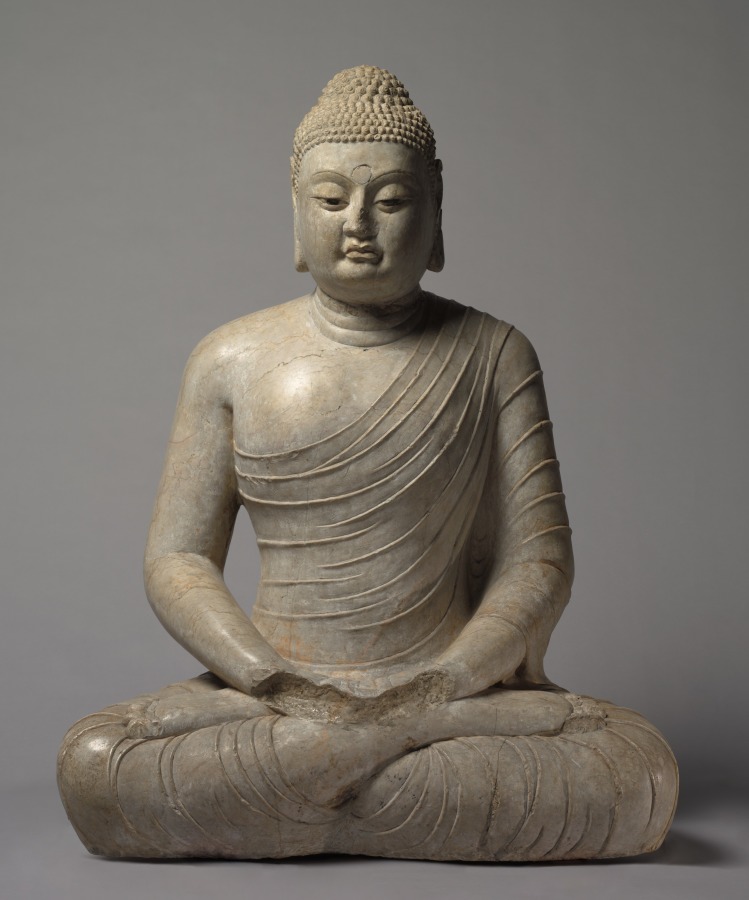
Structural Poetics: The Seated Amitayus Buddha as Architectural Prototype
The Seated Amitayus Buddha presents a definitive study in compressed verticality and contained mass. Unlike the dynamic, outward-thrusting forms of Western Baroque sculpture, this figure’s geometry is one of internalized tension. The lotus position creates a stable, triangular base—a plinth of absolute stillness. The torso rises as a single, unbroken column, with the shoulders forming a precise, horizontal lintel. The head, crowned with a ushnisha, completes the composition as a perfect, ovoid finial. This is not a body in space; it is space made body. The drapery folds, rendered as parallel, incised lines, do not describe anatomy but rather function as architectural fluting, channeling the eye upward in a rhythm of serene repetition. For the 2026 executive silhouette, this translates into a monolithic coat—a single, unseamed length of fabric from shoulder to hem, with zero surface interruption. The collar is a high, standing band, a direct translation of the Buddha’s neck rings. The silhouette is not fitted but enveloping, a sheath of quiet authority.
Urban Materiality: The Udumbara Paradox
The internal DNA of “Udumbara Flowers” (Udonge) operates as a counter-materiality to the Buddha’s stone or bronze. The plaque’s aesthetic—a parasitic bloom on decay—introduces the concept of ephemeral permanence. The white, umbrella-shaped clusters are not depicted with botanical realism; they are abstracted into calligraphic marks, tiny explosions of ink on a field of aged wood. This is the poetics of the almost-invisible. For urban materiality, we must source a fabric that mimics this paradox: a double-faced wool crepe in Ivory. One face is a dense, matte surface—the “wood”—a solid, urban barrier. The other face, revealed through a subtle, laser-cut perforation pattern, shows a fine, silver-grey underlayer—the “flower.” The pattern is not floral; it is a geometric lattice of micro-circles, each one a void that contains its own light. This is not decoration; it is structural subtraction. The garment breathes not through ventilation but through absence.
The Hunt as Tension: Dynamic Counterpoint in Static Form
Where the Buddha offers stillness, “The Hunt” provides the necessary dynamic counterpoint. The Rubens-esque violence—the twisted limbs, the blood-red sky, the diagonal thrust of spears—is not to be reproduced but abstracted into structural tension. The 2026 silhouette must contain this latent energy. The solution lies in the asymmetric seam. A single, sharp diagonal seam cuts across the back of the coat, from the left shoulder blade to the right hip. This seam is not a tailoring detail; it is a frozen vector of pursuit. It creates a subtle, internal torsion in the fabric, a pull that is felt but not seen. The coat’s front remains placid, a pure, unbroken plane of Ivory. The back, however, holds the memory of the chase. The lining, a flash of Onyx silk charmeuse, is visible only when the wearer moves—a glimpse of the “blood” beneath the calm surface. This is the urban poetics of concealment and revelation.
Geometric Integrity: The Dialectic of Void and Volume
The Buddha’s geometry is one of positive space—the figure fills its own outline completely. The Udumbara, conversely, is a negative-space aesthetic—the flower is defined by the wood it is not. The 2026 silhouette must reconcile these two logics. The coat’s shoulder line is a clean, straight extension of the body, a “Buddha shoulder” that does not slope but projects as a horizontal datum. The sleeve is set in with a zero-ease, creating a seamless transition from body to limb. The hem is a hard, straight line at the knee, a deliberate truncation that denies any organic flow. This is the minimalist imperative: every line is a decision, every seam a statement. The volume is not draped but engineered. The coat’s interior is structured with a hidden, lightweight horsehair canvas, giving it a sculptural rigidity. It stands on its own, an empty vessel that the wearer inhabits.
Color and Light: The Ivory Spectrum
Ivory is not a neutral. It is a color of aged bone, temple stone, and faded manuscript. It absorbs and reflects light in equal measure, creating a surface that is both luminous and opaque. For the 2026 executive, this color signifies power without aggression. It is the color of the Buddha’s skin, the color of the Udumbara’s bloom, the color of the sky before the hunt begins. The fabric’s weave is a micro-herringbone, visible only under direct light, a subtle texture that mimics the incised folds of the statue. This is not a color that shouts; it is a color that endures. It is the urban equivalent of temple silence.
Conclusion: The Executive as Vessel
The Seated Amitayus Buddha, filtered through the Udumbara’s ephemeral logic and the Hunt’s latent violence, yields a silhouette that is both sanctuary and armor. The 2026 executive does not wear a coat; they inhabit a structure. The garment’s geometry is a dialectic of stillness and tension, of void and volume. It is a minimalist manifesto written in Ivory wool and Onyx silk. The wearer becomes the axis mundi—the point around which the city’s chaos organizes itself. This is not fashion. This is urban architecture for the body.