Urban Form: Sleeping Endymion
Executive Summary: The Architecture of Absence
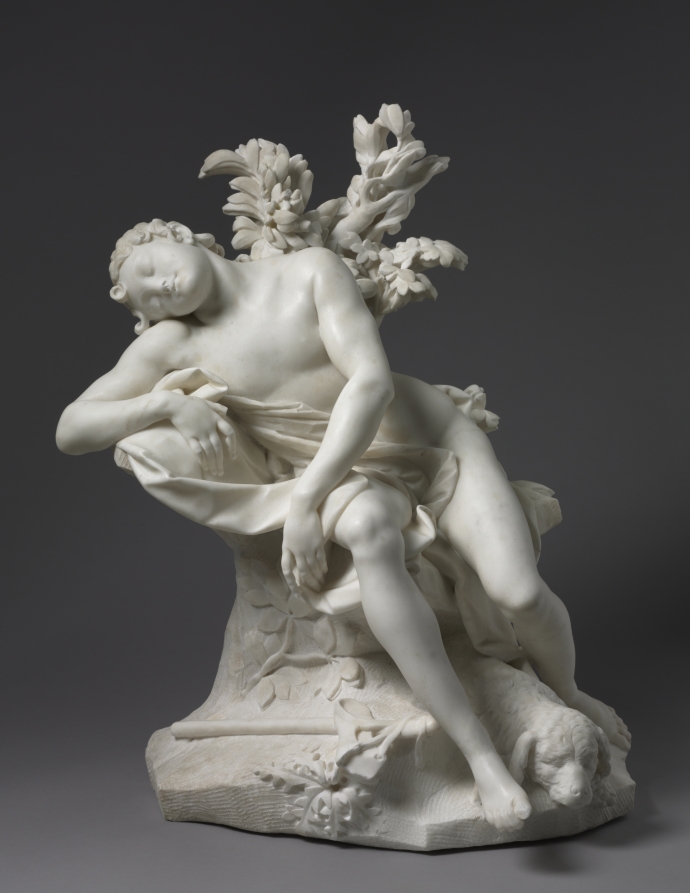
This Urban Silhouette Research for Addison Fashion NYC deconstructs the aesthetic DNA of the Sleeping Endymion subject, drawing from two disparate yet philosophically convergent artifacts: the “Udumbara Flowers” (Udonge) Temple Plaque from a Kyoto temple and Piero della Francesca’s “The Hunt.” The former is a signifier of the nonexistent—a name for a flower that blooms once in three millennia, rendered in gold on moss-green wood. The latter is a Renaissance masterwork of arrested motion, where hunters and hounds are frozen in a geometry of eternal stillness. Both artifacts operate on a principle of negative capability: they do not present a thing, but rather the space around a thing—the pause before the arrow flies, the silence before the flower appears. For the 2026 NYC executive wardrobe, this translates into a Minimalist silhouette system that prioritizes form over ornament, volume over mass, and interval over continuity. The primary color, Slate, is chosen not as a neutral, but as a chromatic void—a tone that absorbs light and refuses to declare itself, mirroring the plaque’s refusal to depict the flower it names.
I. Silhouette Deconstruction: The Geometry of Stillness
A. The Shoulder: The Hunt’s Frozen Arrow
In “The Hunt,” the archer’s bow is drawn but never released. The tension is not in the action, but in the potential energy of the pose. For the 2026 executive, the shoulder line must replicate this suspended tension. We reject the aggressive, padded shoulder of the 1980s power suit, which signals overt dominance. Instead, we propose a sculpted, extended shoulder that is softly structured—a clean, horizontal line that terminates without sharp points. The construction uses a floating canvas technique: the shoulder pad is not sewn into the sleeve head but suspended between the lining and outer shell, creating a micro-gap of air. This gap is the negative space of the archer’s bowstring—a millimeter of possibility. The result is a silhouette that holds its shape without rigidity, suggesting authority without aggression.
B. The Torso: The Udonge Plaque’s Void
The plaque’s power lies in its absence of the flower. The gold calligraphy names something that is not there. The torso of the garment must operate on the same principle: it should enclose the body without defining it. We employ a semi-fitted, columnar cut that falls from the shoulder with a slight A-line expansion. The fabric is double-faced wool crepe in Slate, chosen for its dead-stretch—it moves with the body but returns to its original shape, resisting the imprint of the wearer. The waist is not suppressed; there is no dart, no seam to indicate where the body ends and the garment begins. This is the architectural equivalent of the plaque’s blank space: the garment is a container for a presence that is never fully revealed. The interior is lined with charcoal silk charmeuse, a hidden luxury that only the wearer knows—a private reference to the unseen flower.
C. The Sleeve: The Interval of Time
Both artifacts deal with temporal suspension. The plaque waits for a flower that will not bloom for millennia; the painting freezes a moment that never resolves. The sleeve must embody this interval. We propose a three-quarter length, set-in sleeve with a subtle, forward pitch. The hem is left unfinished—a raw edge that is hand-rolled and tacked with a single, invisible stitch. This is not a sign of deconstruction, but of deliberate incompletion. The sleeve ends not at the wrist, but at the point where the hand becomes active—a pause before the gesture. The pitch of the sleeve creates a slight break at the elbow, a fold that mimics the crease in the hunter’s tunic as he draws his bow. This is the fabric memory of a motion that never happens.
II. Color Theory: Slate as Chromatic Silence
A. The Philosophy of Slate
Slate is not a color in the traditional sense; it is a non-color—a composite of black, gray, and a whisper of blue-green, like the moss on the Kyoto plaque seen through twilight. It is the color of stone that has been wet and dried, of ink that has faded. In the context of the Sleeping Endymion research, Slate functions as the visual equivalent of the Udonge flower: it is present but not declarative. It absorbs light rather than reflecting it, creating a matte, velvety surface that does not compete with the wearer’s presence. For the 2026 executive, this is critical. The garment must not perform; it must enable. Slate allows the body to be the primary text, with the garment as a quiet footnote.
B. Chromatic Layering: The Hunt’s Shadow
In “The Hunt,” della Francesca uses chiaroscuro not for drama, but for spatial definition. His shadows are cool, blue-gray—they do not obscure, but rather reveal form through absence of light. We apply this principle through tonal layering. The primary garment is Slate, but we introduce a secondary layer in Onyx (a deep, matte black) for the interior lining and a tertiary accent in Ivory for the single visible stitch at the sleeve hem. This is not a color palette; it is a value system. The Onyx creates the shadow volume inside the garment, while the Ivory stitch is the single point of light—the moment in the painting where the hunter’s eye catches the sun. The overall effect is monochromatic but not flat, a gradient of absence.
III. Fabric and Construction: The Materiality of the Void
A. The Plaque’s Texture: Moss and Metal
The Kyoto plaque combines moss-green wood (organic, porous, matte) with gold leaf (inorganic, reflective, sharp). This tension between textures is the core of the fabric selection. The primary fabric is a wool-cashmere blend with a felted finish—it is dense, quiet, and slightly napped, like moss. The secondary fabric, used for the interior pocket welt and the button cover, is a brushed silk satin with a subtle, irregular sheen—the gold leaf of the plaque, but muted. The buttons themselves are oxidized silver, left unpolished, with a matte, lunar surface that references the Sleeping Endymion myth (the moon’s lover). They are not decorative; they are functional anchors that hold the garment’s geometry in place.
B. The Painting’s Geometry: Seam as Line
Della Francesca’s compositions are built on precise, geometric lines—the diagonal of the spear, the horizontal of the horizon, the vertical of the tree trunk. The garment’s seams must be equally deliberate and minimal. We use a princess seam construction for the bodice, but the seams are pressed open and top-stitched with a single, hairline thread in a slightly darker Slate. This creates a visible but not prominent line, like the gold calligraphy on the plaque—it defines the form without interrupting it. The hem is weighted with a thin chain sewn into the facing, ensuring the garment falls with a single, clean line—the hunter’s arrow, frozen in its trajectory.
IV. The 2026 Executive Wardrobe: A System of Intervals
The final garment is not a standalone piece, but the anchor of a modular system. It is designed to be worn with high-waisted, straight-leg trousers in the same Slate wool crepe, creating a continuous column of color. The trousers feature a flat front, no belt loops, and a side zip closure—no visible hardware, no interruption of the line. The only accent is a single, horizontal tuck at the knee, a fold that suggests the pause of the hunter’s stride. The entire ensemble is a study in intervals: the space between the shoulder and the sleeve, the gap between the jacket hem and the trouser waist, the silence between the wearer’s movements. It is a wardrobe for the executive who understands that true power is not in the statement, but in the pause before the statement—the three-thousand-year wait for a flower that never blooms, the frozen moment before the arrow flies. In Slate, it is the color of that waiting.