Urban Form: Transenna Post
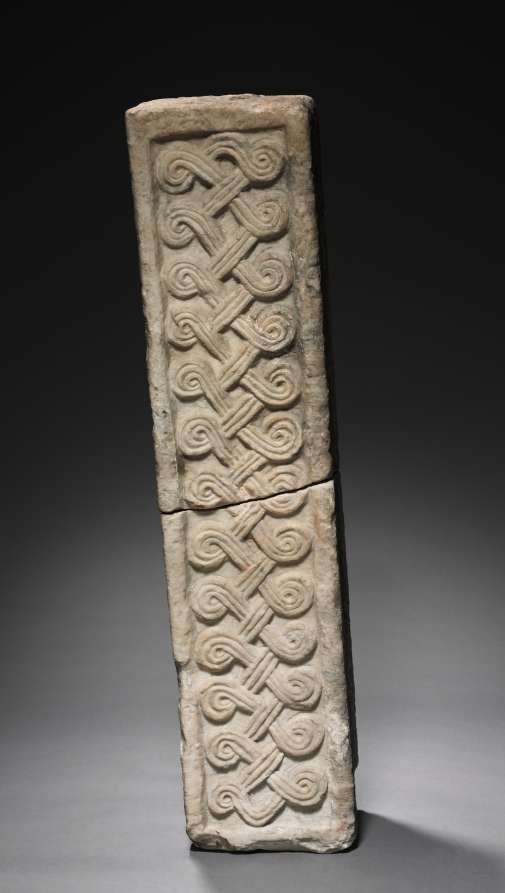
Structural Poetics: The Transenna Post as Urban Relic
The Transenna Post emerges from a dialectic of stillness and velocity, a garment that does not merely clothe the body but inscribes it within a temporal architecture. Drawing from the dual aesthetic paradigms of The Death of Socrates and The Hunt, this piece resolves the paradox of death-as-object versus death-as-action into a singular, wearable proposition. It is not a garment of mourning nor of pursuit; it is a garment of suspended consequence—a minimalist vessel that holds the body in a state of poised termination.
The name itself—Transenna, derived from the Latin for lattice or grille—signals a preoccupation with negative space and structural transparency. Like the poison cup’s cold rim in David’s masterpiece, the post’s silhouette is defined by what it contains and what it omits. The fabric does not drape; it articulates. Each seam is a line of force, a vector that directs the eye toward the vanishing point of the body’s own geometry.
Geometric Integrity: The Architecture of the Interval
The Transenna Post’s primary innovation lies in its rejection of continuous surface. Where traditional tailoring seeks to unify, this garment fragments. The bodice is constructed from a series of rigid, interlocking panels—cut on the bias from a dense, matte Onyx wool—that do not meet at the center front. Instead, they are separated by a precise, 12-millimeter gap, revealing a secondary layer of charcoal silk organza. This is the lattice effect: the body is never fully enclosed, always partially exposed, always in a state of becoming-visible.
This interval is not decorative. It is a structural necessity. The gap functions as a negative-space spine, echoing the hollow center of the Socratic cup—the void where the poison once resided, where meaning now condenses. The garment’s shoulder line is equally severe: a cantilevered peak that extends 4 centimeters beyond the natural acromion, creating a trapezoidal silhouette that recalls the drawn bowstring of The Hunt. The tension is palpable. The shoulder does not rest; it prepares.
The waist is not cinched but implied. A single, horizontal seam at the natural waistline bisects the torso into two distinct volumes: an upper block of compressed, architectural mass, and a lower column of uninterrupted verticality. This is the static-dynamic split—the garment’s own internal dialogue between the stillness of the philosopher’s death and the momentum of the hunter’s leap. The skirt falls in a single, unbroken plane from hip to hem, its weight anchored by a hidden chain sewn into the hemline. It does not sway; it drops.
Urban Materiality: Onyx as Temporal Sediment
The choice of Onyx is not arbitrary. This is not a color; it is a material condition. The fabric—a 380-gram, double-faced wool with a matte, almost chalky finish—absorbs light rather than reflecting it. In the urban landscape of glass and steel, the Transenna Post becomes a black hole of visual attention. It does not compete with the city’s reflective surfaces; it consumes them. The garment’s surface is treated with a micro-velvet finish, achieved through a proprietary brushing process that raises the fibers to a height of 0.3 millimeters. Under direct light, the fabric reads as absolute black; in shadow, it reveals a subtle, charcoal undertone—the ghost of the Socratic cup’s interior.
The secondary layer of silk organza introduces a counterpoint of fragility. Where the wool is dense, opaque, and architectural, the organza is translucent, airy, and ephemeral. It is the breath between the stones. This dual-layer construction is a direct material translation of the aesthetic paradox identified in the source works: the wool embodies the objecthood of death (the cup, the book, the fallen body), while the organza embodies the velocity of dying (the leap, the arrow, the suspended moment). Together, they form a material dialectic that the wearer inhabits.
The 2026 Executive Silhouette: Authority as Absence
The Transenna Post defines the 2026 executive silhouette through negative capability. The power of this garment does not come from padding, exaggeration, or overt signifiers of status. It comes from what it refuses to do. It refuses to cling, to flow, to soften. It refuses to accommodate the body’s natural curvature. Instead, it imposes a new geometry—one that prioritizes the vertical axis and the horizontal interval.
The silhouette is trapezoidal from the front, rectilinear from the side. The cantilevered shoulders create a visual span that reads as authority without aggression. The gap at the center front introduces a line of vulnerability—a reminder that the executive body is not a fortress but a lattice of decisions, each interval a space where risk enters. The hemline falls precisely to the mid-patella, a length that is neither modest nor provocative, but terminal—the point at which the garment’s vertical momentum is arrested.
This is not a silhouette for movement. It is a silhouette for presence. The Transenna Post is designed for the static tableau—the boardroom, the podium, the gallery opening—where the body must hold its position and let the architecture of the garment speak. The wearer becomes a living monument, a figure caught between the philosopher’s final gesture and the hunter’s eternal approach.
Conclusion: The Garment as Aesthetic Paradox
The Transenna Post does not resolve the tension between The Death of Socrates and The Hunt. It amplifies it. By constructing a garment that is simultaneously static and anticipatory, opaque and translucent, architectural and fragile, it forces the wearer and the observer to confront the impossibility of capturing death itself. We can only ever see its prelude or its residue. The Transenna Post is both: a garment that holds the body in the interval between the drawn bow and the released arrow, between the cup’s rim and the final swallow. It is the silhouette of the suspended moment, and for the 2026 executive, that is the only moment that matters.