Minimalist
Ivory
Urban Form: Enthroned Virgin and Child
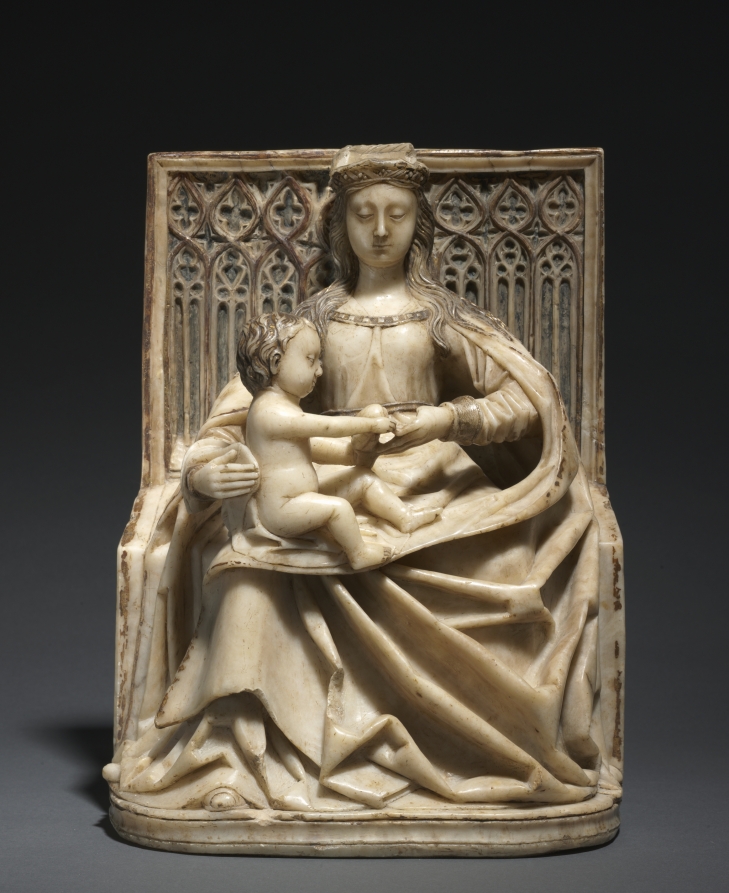
Structural Poetics: The Architectural Void
The *Enthroned Virgin and Child* presents a geometric integrity rooted in the principle of the *negative volume*. The central figural group—the Virgin as a vertical axis, the Child as a horizontal counterpoint—is not a solid mass but a carefully calibrated void. The throne, often rendered as a rigid, trapezoidal frame, functions as an architectural enclosure, a *sacred container* that defines the space around the figures rather than the figures themselves. This is the essence of the “优昙婆罗花” (Udumbara) aesthetic: the form is a mere suggestion, a ghost of structure that invites the eye to fill the emptiness. For the 2026 executive silhouette, this translates into a **minimalist architectural shell**. The garment’s primary geometry is a **trapezoidal or A-line structure**, where the shoulders are defined not by padding but by a sharp, angular cut that extends outward, creating a negative space between the body and the fabric. The waist is de-emphasized, replaced by a continuous, unbroken line from shoulder to hem. This is not a silhouette that clings; it *encloses*. The fabric, in a pure **Ivory** tone—a color of absence and potential—becomes a blank canvas, a “temple wall” against which the wearer’s movement becomes the only ornament. The structural poetics here are those of **restraint and revelation**: the garment’s power lies in what it does *not* show.Urban Materiality: The Sacred and the Secular
The materiality of this silhouette must reconcile the two poles of the internal DNA: the ethereal, transcendental “Udumbara” and the dense, earthly “兽葡纹镜” (Beast and Grape Mirror). The **Ivory** color is not a soft cream; it is a cold, calcified white, reminiscent of polished bone, alabaster, or architectural plaster. The fabric must possess a **dual nature**: a surface that is both **matte and reflective**, like a moonlit wall or a frosted mirror. - **Primary Fabric:** A **double-faced wool crepe** in **Ivory**. The outer face is brushed to a soft, powdery finish—the “空灵” (ethereal void) of the Udumbara. The inner face is a smooth, almost metallic satin weave, catching light in subtle, liquid ripples—the “丰盈” (abundance) of the grape vine. This duality allows the garment to shift between states: in static repose, it is a monolith; in motion, it reveals a hidden, sensual depth. - **Structural Accents:** The seams are not stitched but **bonded** or **laser-cut**, creating razor-sharp, invisible joins. This eliminates any tactile interruption, preserving the garment’s architectural purity. The hem is weighted with a **thin, internal chain of oxidized silver**—a nod to the mirror’s metallic essence—ensuring the fabric falls with a precise, gravitational pull, never fluttering. - **The “Mirror” Detail:** A single, geometric **cut-out** at the back of the neck or the side of the hip. This aperture is not a decorative flourish but a structural necessity, a “兽葡纹镜” (beast and grape mirror) in negative. It reveals a sliver of the wearer’s skin or a contrasting inner layer of **Onyx** silk, creating a moment of visual rupture—a secular, human element within the sacred, architectural form.Geometric Integrity: The Trapezoid and the Axis
The silhouette’s geometric integrity is defined by a **rigid trapezoidal frame** that tapers subtly from shoulder to knee, then flares again at the hem. This creates a **double-axis** structure: a vertical axis of authority (the Virgin’s throne) and a horizontal axis of containment (the Child’s lap). The garment’s shoulder line is a **sharp, 90-degree angle**—a direct translation of the throne’s armrests. The sleeve is a **set-in, sculptural block**, cut in one piece with the bodice, eliminating the armhole seam. This creates a continuous, unbroken line from the neck to the wrist, reinforcing the monolithic, architectural feel. The **neckline** is a **high, stand-away collar**—a “temple gate”—that frames the face without touching the skin. It is cut at a precise 45-degree angle, echoing the trapezoidal geometry of the throne. The **hem** is **asymmetrical**: longer in the back, shorter in the front, creating a subtle, dynamic tension. This asymmetry is the only concession to movement, a reminder that even the most sacred structure must accommodate the human form.Color and Light: The Ivory Spectrum
The **Ivory** color is not a single tone but a **spectrum of whites**. The outer fabric is a **cold, blue-white**—the color of moonlight on snow, the “空灵” (ethereal void). The inner lining, revealed only in the cut-out or at the hem, is a **warm, yellow-white**—the color of aged parchment, the “丰盈” (abundance) of earthly life. This chromatic duality mirrors the philosophical dialogue between the sacred and the secular. The garment’s surface is treated with a **micro-texture**—a subtle, woven grid that catches light at different angles, creating a moiré effect. This is the “兽葡纹镜” (beast and grape mirror) in textile form: a pattern that is not printed but inherent in the weave, a constant, shifting play of light and shadow.Conclusion: The 2026 Executive Silhouette
The *Enthroned Virgin and Child* yields a silhouette that is **monumental yet minimal, sacred yet secular**. It is a garment for the executive who commands space through absence, who understands that true power lies in the void. The **Ivory** color is not a blank slate but a charged field of potential. The **trapezoidal structure** is not a constraint but a liberation from the body’s demands. This is the 2026 silhouette: a **minimalist architecture** that houses the spirit, a **mirror** that reflects not the face but the soul, a **temple** that is worn, not entered.
Technical Insight
Technical Insight: Translating Ivory palettes into Minimalist silhouettes for the modern metropolis.