Urban Form: Mourner from the Tomb of Philip the Bold, Duke of Burgundy (1364–1404)
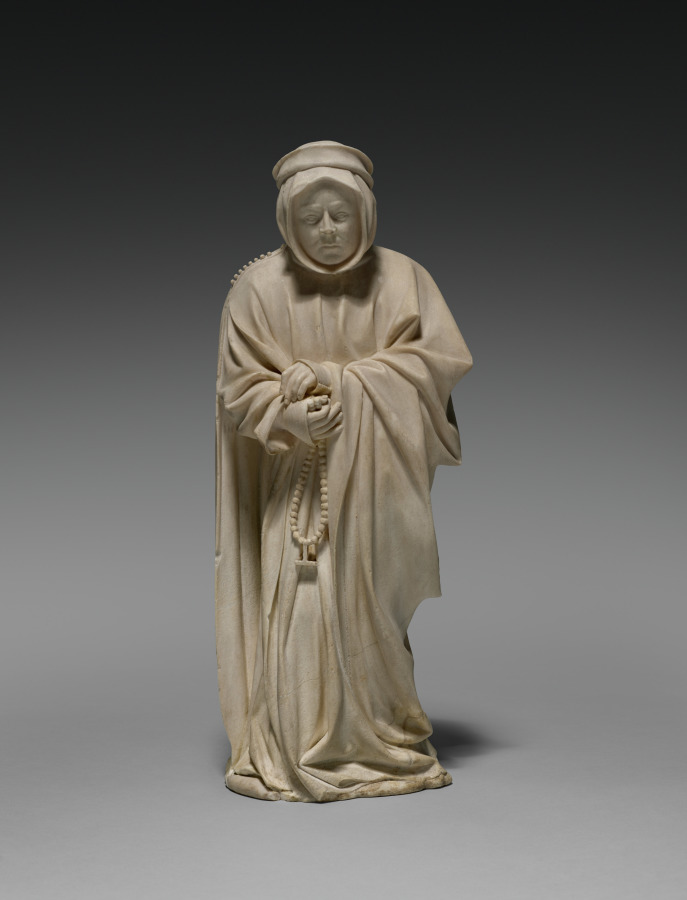
Geometric Integrity of the Mourner: A Study in Vertical Compression and Draped Mass
The *Mourner from the Tomb of Philip the Bold* is a masterpiece of late medieval Burgundian sculpture, executed in alabaster with a precision that belies its funerary purpose. For the 2026 executive silhouette, this figure offers a radical departure from the fluid, organic forms of contemporary fashion. Its geometric integrity is defined by a strict, almost architectural verticality, where the human form is subsumed into a cascade of heavy, pleated fabric. The mourner’s posture—a bowed head, shoulders drawn inward, hands clasped in prayer—creates a closed, introverted volume. This is not a silhouette of expansion or power in the traditional sense, but one of concentrated, internalized presence.The key structural principle is vertical compression. The figure’s height is emphasized by the uninterrupted fall of the cloak, which creates a single, monolithic column from shoulder to hem. There is no waist definition, no flaring of the skirt; instead, the fabric pools at the feet in a series of deep, static folds. This is a direct counterpoint to the dynamic, swirling lines of the Musician Pottery Fragment mentioned in the internal DNA. Where the Chinese fragment captures a moment of outward, kinetic energy, the Burgundian mourner embodies a state of arrested motion—a frozen, eternal stillness. For the Addison Fashion executive, this translates into a silhouette that is Oversized in volume but Minimalist in line. The coat or dress must have a weighty, substantial drape, achieved through dense wool or bonded jersey, that falls without interruption. The shoulder line should be slightly dropped and rounded, not sharp, to mimic the mourner’s bowed posture. The hem should be clean, almost architectural, skimming the floor without pooling excessively.
Structural Poetics: The Fold as a Carrier of Emotion
The internal DNA’s dialectic of “dynamic vitality” versus “static eternity” finds its perfect resolution in the mourner’s folds. Unlike the flowing, organic pleats of classical drapery, these folds are deep, angular, and repetitive. They are not decorative; they are structural. Each fold acts as a vertical rib, reinforcing the columnar shape while simultaneously creating a subtle, rhythmic play of light and shadow. This is the urban poetics of the piece: the folds become a metaphor for the city’s vertical grid, the repetitive facades of skyscrapers, the disciplined rhythm of the workday.The Arhat paintings from the internal DNA offer a parallel in their depiction of “absolute stillness” through meticulous line work. The mourner’s folds, like the arhat’s robe, are rendered with a precision that borders on the obsessive. Every crease is deliberate, every shadow calculated. For the 2026 executive, this suggests a garment where the construction is the design. Seams should be visible, not hidden; pleats should be pressed with military sharpness; the fabric should hold its shape like a sculpted form. The structural poetics lie in the tension between the garment’s heavy, almost funerary weight and the wearer’s living, breathing body. The wearer becomes the mourner, carrying the weight of urban existence with stoic grace.
Urban Materiality: Slate as a Palette of Silence
The color Slate is not a choice; it is a necessity. It is the color of wet pavement, of the sky before a storm, of the stone from which the mourner is carved. In the context of the 2026 executive silhouette, Slate functions as a neutral of profound gravity. It absorbs light rather than reflecting it, creating a matte, non-reflective surface that emphasizes form over ornament. This aligns with the Minimalist category, where color is reduced to its essential, almost architectural function.The materiality must echo the alabaster’s cold, smooth tactility. We propose a double-faced wool crepe with a brushed finish, giving it a slight, velvety nap that mimics the soft, worn surface of ancient stone. Alternatively, a bonded technical jersey with a matte, silicone-like coating could achieve the same effect, offering the necessary weight and drape while providing the urban practicality of wrinkle resistance and ease of movement. The fabric should feel substantial, almost heavy, in the hand, yet hang with a fluid, uninterrupted fall. This is the urban materiality of the piece: a fabric that is both ancient and futuristic, both sacred and secular.
Silhouette Application for the 2026 Executive
The definitive garment is a floor-length, single-seam coat with a hood that can be worn up or down. The hood, when worn, should completely obscure the face, echoing the mourner’s anonymity and creating a sense of urban camouflage. The coat should have no buttons, no zippers, no visible fastenings. It is closed by the wearer’s hands, clasped together at the chest, or by a single, hidden magnetic closure at the sternum. The sleeves are set-in, but cut with a slight batwing extension to allow for the folded-arm posture. The hem is raw, cut with a laser to prevent fraying, and left unhemmed to emphasize the garment’s sculptural, unfinished quality.This is not a garment for the faint of heart. It is a garment for the executive who understands that true power lies in stillness, in the ability to command a room through presence rather than movement. It is a garment that references the Mourner’s eternal vigil, the Arhat’s transcendent calm, and the Musician Fragment’s frozen moment of joy. It is, in essence, a wearable sculpture—a piece of urban armor that allows the wearer to move through the city as a silent, dignified monument to their own ambition.