Minimalist
Ivory
Urban Form: Samite fragment with hunters
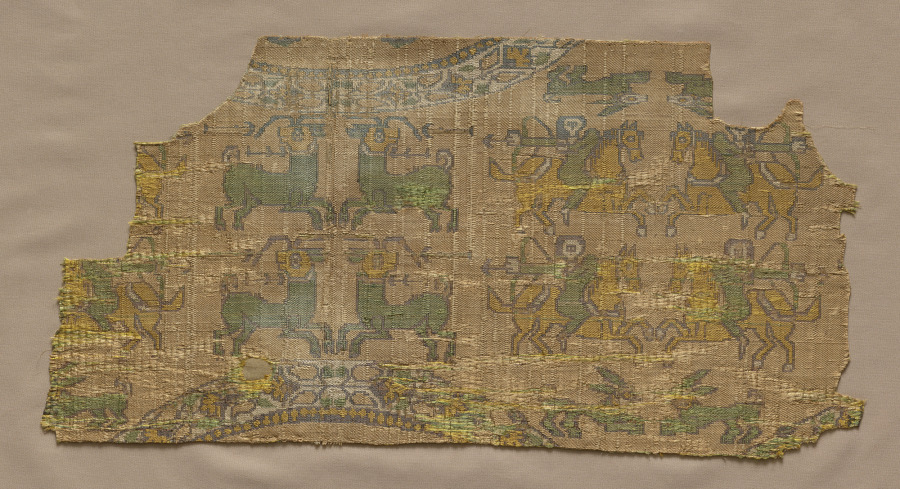
Structural Poetics: The Samite Fragment as Architectural Blueprint
The samite fragment with hunters, a textile artifact of Byzantine or early medieval provenance, presents a paradox of materiality and representation. Its woven surface—a dense, patterned field of silk threads—captures a hunting scene in a state of arrested motion. For the 2026 executive silhouette, this fragment offers a critical lesson in geometric integrity: the tension between the static grid of the weave and the dynamic, diagonal thrust of the hunters’ bodies. The fabric’s structure is not merely a support for imagery; it is the imagery itself. Each thread, each warp and weft, constitutes a unit of space, a pixel of luxury. The hunters, their horses, and the prey are not painted but *constructed* from these units, their forms emerging from the disciplined repetition of the loom. This is the foundational principle for the Addison Fashion urban silhouette. The 2026 executive must embody a similar logic: a garment that is not draped but *built*. The samite fragment’s geometric integrity lies in its refusal to separate ornament from structure. The hunters are not appliquéd; they are integral to the textile’s tensile strength. In our design language, this translates to a jacket or coat where the silhouette’s volume is generated by the fabric’s own rigidity—a double-faced wool or a bonded silk organza that holds a sharp, architectural line without internal padding. The shoulder becomes a cantilever, the sleeve a clean, vertical drop. The pattern pieces are cut with the precision of a blueprint, each seam a line of force that directs the eye along the body’s axis.The Urban Poetics of the Hunt: Diagonal vs. Orthogonal
The hunting scene within the samite is not chaotic. It is a controlled composition of diagonals—the spears, the leaping hounds, the arched necks of the horses—cutting across the orthogonal grid of the weave. This is the core of urban poetics: the introduction of dynamic, asymmetrical elements within a rigorously ordered framework. For the 2026 silhouette, this manifests as a deliberate disruption of the classic minimalist line. Consider a long, columnar coat in ivory wool. Its primary geometry is a clean, vertical rectangle. Yet, a single, sharp seam cuts diagonally from the left shoulder to the right hip, echoing the hunter’s spear. This seam is not decorative; it is a structural dart that redefines the garment’s volume, creating a subtle, three-dimensional torsion. The fabric folds and falls along this line, generating a shadow that mimics the depth of the woven silk. The color ivory is chosen for its spectral neutrality. It is not a blank; it is a surface that captures and diffuses urban light—the grey-white of winter sky, the pale gleam of polished concrete. In the samite, the ivory (or its aged equivalent) of the silk ground allows the darker threads of the hunters to emerge with clarity. In our garment, the ivory fabric becomes the ground, and the diagonal seam—perhaps piped with a fine, onyx-black cord—becomes the figure. The urban materiality is thus one of *negative space* and *positive line*. The body is not displayed but *framed* by the garment’s geometry.Materiality as Metaphor: The Weave of the City
The samite fragment is a relic of a world where textiles were the primary medium of narrative and status. Its materiality—the tight, lustrous weave of silk—speaks of a civilization that valued density, durability, and a surface that could hold a story. For the 2026 executive, materiality is not about softness or comfort; it is about *presence*. The urban environment demands a fabric that can withstand the friction of crowds, the glare of glass towers, the constant movement of the body through space. We propose a fabric that mimics the samite’s structural logic: a double-faced wool crepe, woven with a subtle herringbone pattern that references the textile’s grid. The surface is matte, absorbing light rather than reflecting it, creating a silhouette that is both monolithic and mobile. The hunters on the samite are frozen in a moment of eternal pursuit. This is the urban condition: a constant state of forward motion, of chasing the next horizon. The garment’s silhouette must accommodate this. The coat’s hem is cut clean and straight, falling just below the knee. The sleeves are set with a high armhole, allowing for unrestricted movement. The back is cut in one piece, with a single center seam that follows the spine, creating a vertical line of gravity. The front, however, is where the diagonal intervention occurs. A hidden placket, secured with invisible magnetic closures, maintains the clean facade. The only visible hardware is a single, polished brass zipper pull at the collar—a small, urban detail that catches the light like a hunter’s buckle.Conclusion: The Silhouette as a Fragment of Eternity
The samite fragment with hunters is not a complete narrative. It is a piece of a larger whole, a fragment that implies a lost context. The 2026 executive silhouette, in its minimalist rigor, operates on the same principle. It is not a complete statement of the self; it is a fragment of a larger urban existence. The garment’s geometry—the orthogonal grid of the weave, the diagonal thrust of the seam—creates a space for the wearer to inhabit, a structure that is both protective and expressive. The ivory color is the ground, the urban canvas. The diagonal line is the hunter’s path, the vector of ambition. The result is a silhouette that is not merely worn but *inhabited*—a piece of architectural poetics that moves through the city with the quiet authority of a woven fragment from a forgotten empire.
Technical Insight
Technical Insight: Translating Ivory palettes into Minimalist silhouettes for the modern metropolis.