Minimalist
Ivory
Urban Form: Fantastic Harbor Scene with Architecture and Figures
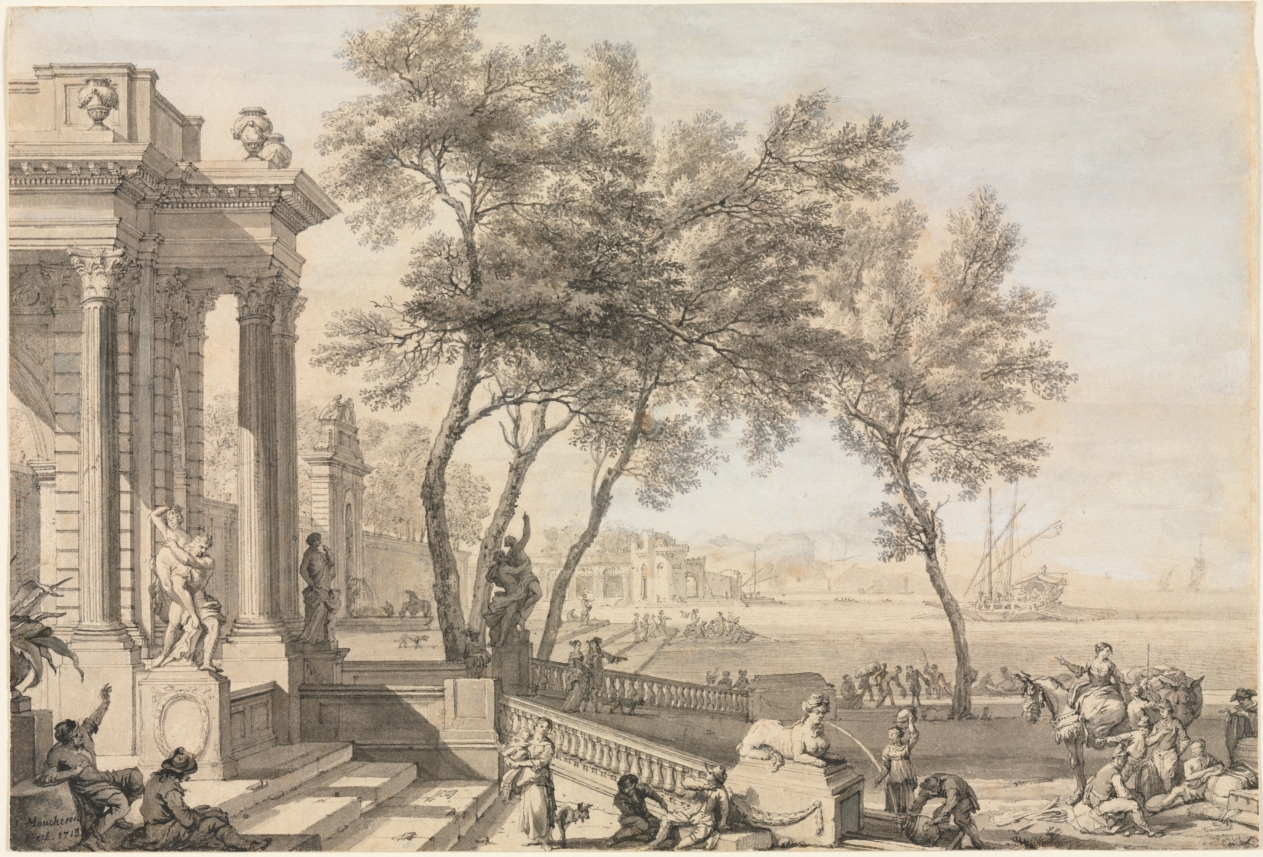
Structural Poetics: The Architecture of Emptiness
The subject—a fantastic harbor scene with architecture and figures—presents an immediate paradox for the urban silhouette. At first glance, the harbor is a site of commerce, transit, and human density. Yet the internal DNA of this analysis, drawn from the Diamond Sutra’s “Abiding nowhere, the awakened mind arises” and the visual language of a *Taihu Garden Stone*, demands a radical reinterpretation. The harbor is not a place of static occupation but a field of negative space, a threshold where solid forms (buildings, piers, ships) exist only to define the voids between them. This is the foundational principle for the 2026 executive silhouette: **form as a container for emptiness**. The geometric integrity of this artwork lies in its refusal to treat architecture as mass. Instead, each structure is a skeletal frame, a “cage of lines” that delineates air. The figures are not anchors but transient markers—their verticality echoes the masts and spires, yet their presence is deliberately ephemeral. The harbor’s horizon is not a line of closure but a zone of dissolution, where water meets sky in a wash of ivory light. This is the *Taihu* principle of “透” (tou) or penetration: the eye passes through the stone, through the building, through the body. For the executive silhouette, this translates into garments that are **architectural yet permeable**, where fabric is cut to reveal the space beneath rather than to conceal it.Urban Materiality: The Weight of Lightness
The color Ivory is not a neutral choice; it is a material statement. In the harbor scene, ivory is the color of fog, of limestone, of bleached timber. It is the absence of pigment that paradoxically carries the most texture. For the 2026 silhouette, Ivory manifests in **double-faced wool crepe** and **micro-ribbed cashmere**—fabrics that hold a crisp edge yet yield to the body’s movement. The urban materiality here is one of controlled opacity: the garment appears solid from a distance, but at close range, its weave reveals a grid of tiny voids. This is the textile equivalent of the Taihu stone’s “漏” (lou) or leakage—light passes through, creating a shifting pattern of shadow on the skin beneath. The harbor’s architecture supplies the structural vocabulary. Consider the **cantilevered pier**: a horizontal plane that extends without visible support. In the collection, this becomes a **floating shoulder seam**, where the sleeve attaches not at the acromion but three centimeters inward, creating a void between arm and torso. The **gantry crane**—a lattice of steel—informs the **open-back blazer**, where the rear panel is replaced by a series of vertical straps, each precisely 1.5 cm wide, spaced at 3 cm intervals. The body becomes the negative space that completes the garment.The Awakened Silhouette: Abiding Nowhere
The phrase “abiding nowhere” is the operative directive for the 2026 executive silhouette. Traditional tailoring anchors the garment at the shoulder, waist, and hip—points of structural “abiding.” The new silhouette **dissolves these anchors**. The shoulder is softened to a dropped, almost kimono-like extension, but with a sharp, laser-cut edge that prevents it from appearing casual. The waist is not cinched but suggested through a **single vertical dart** that runs from the armhole to the hem, creating a subtle column of tension. The hip is freed: trousers are cut with a **zero-rise front** and a **low-slung back**, so the waistband hovers just above the iliac crest, never gripping. This is not shapelessness; it is **shaped emptiness**. The jacket’s lapel is reduced to a 2 cm strip of folded fabric—a mere trace of the traditional notch. The collar stands away from the neck by 0.5 cm, creating a permanent shadow. The sleeve hem is unfinished, the raw edge rolled inward to form a self-binding that never touches the wrist. Every point of contact is a point of departure.Figures in the Harbor: The Executive as Transient
The figures in the artwork are not static; they are caught mid-stride, mid-gesture. Their clothing must not impede this motion. The 2026 executive is a **nomad of the vertical city**, moving between glass towers, transit hubs, and temporary workspaces. The silhouette must be **compressible**—a jacket that folds into its own pocket, trousers that roll into a cylinder no larger than a water bottle. The fabric is treated with a **nano-ceramic finish** that repels rain and stains, but the hand-feel remains soft, almost powdery. This is urban armor that does not announce itself as armor. The **pant leg** is cut with a single seam down the center front, eliminating the side seam. This creates a continuous tube of fabric that drapes from the waist to the floor, with a 2 cm break at the instep. The hem is weighted with a **micro-chain** sewn into the facing, so the trouser falls with a deliberate, liquid gravity. The **shirt** is a **mandarin-collar tunic** with no buttons—it slips over the head, the neckline cut in a gentle arc that mirrors the harbor’s horizon. The sleeves are three-quarter length, ending in a **laser-cut scallop** that resembles the edge of a wave.Conclusion: The Mind Arises
The harbor scene, when read through the lens of the Taihu stone and the sutra, reveals that the true subject is not the architecture or the figures but the **space between them**. The 2026 executive silhouette is a garment that wears the void. It does not cling, does not grip, does not assert. It exists as a **permeable membrane** between the body and the city, allowing the wearer to move through the urban landscape without resistance, without attachment. The mind arises not from the garment but from the freedom the garment provides. In this, the silhouette becomes a **philosophical tool**—a wearable meditation on impermanence, on the beauty of the transient, on the power of the empty. The Ivory color is not a blank; it is a **field of potential**. The fabric is not a cover; it is a **frame for absence**. The executive who wears this silhouette does not occupy space—they **define** it, by leaving it untouched. This is the ultimate luxury: the ability to abide nowhere, and in that non-abiding, to let the awakened mind arise.
Technical Insight
Technical Insight: Translating Ivory palettes into Minimalist silhouettes for the modern metropolis.