Urban Form: Wine Flask with Incised and Sgraffito Peony Design
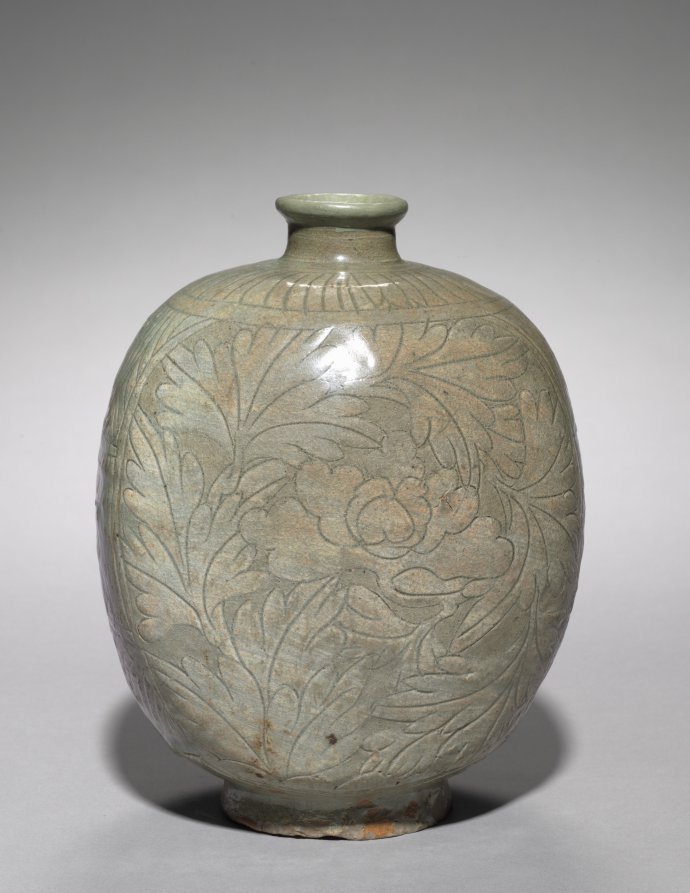
Structural Poetics of the Wine Flask: A Study in Contained Volume and Incised Line
The wine flask, with its incised and sgraffito peony design, presents a masterclass in the tension between contained mass and surface articulation. For the 2026 executive silhouette, this object offers a definitive lexicon: the body as a vessel, the garment as a carved surface. The flask’s geometry is not one of soft, organic flow but of disciplined curvature—a sphere compressed into a functional, portable form. The neck is a deliberate, narrow cylinder; the base, a stable, unyielding plane. This is the architecture of minimalist luxury: every curve serves a structural purpose, every line is a decision.
The peony, rendered through sgraffito—a technique of scratching through a surface layer to reveal a contrasting ground below—is not a decorative afterthought. It is a structural incision. The flower’s petals are not painted onto the surface; they are excavated from it. This is the critical insight for the urban silhouette: the garment’s narrative must be carved, not applied. The 2026 executive silhouette will reject superfluous ornament in favor of negative-space detailing. Think of a double-faced wool coat where the lapel’s edge is cut away to reveal a contrasting underlayer, or a silk blouse where the collar’s interior is etched with a geometric pattern visible only in motion. The peony’s sgraffito teaches us that the most powerful statement is one of removal, not addition.
Geometric Integrity: The Body as a Carved Vessel
The flask’s primary geometry is a truncated sphere—a form that is both generous and controlled. This translates directly into the 2026 executive silhouette as a softened, yet structured, shoulder. The extreme, padded power shoulder of the 1980s is obsolete. Instead, we propose a dolman sleeve with a defined cap, where the volume is concentrated at the upper arm and then tapered cleanly to the wrist. The torso follows suit: a slightly cocooned back that releases into a straight, narrow front. This is not an oversized silhouette; it is a tailored volume. The garment holds the body as the flask holds its liquid—securely, with no wasted space, yet with a palpable sense of interior capacity.
The incised lines of the peony—the fine, deliberate scratches that define each petal—inform the surface treatment of the fabric. For the 2026 collection, we will employ laser-cut suede and bonded jersey where the pattern is etched into the material’s surface. The peony’s radial symmetry suggests a mandala-like layout for these incisions: a central motif at the sternum or the small of the back, with lines radiating outward to the seams. The garment’s surface becomes a topographical map of the wearer’s movement. The sgraffito technique, in particular, demands a two-tone materiality: a charcoal outer layer (Slate) with a silver or ivory underlayer revealed by the incision. This is not print; this is excavation.
Urban Materiality: From Ceramic to Textile
The flask’s material—a high-fired ceramic or stoneware—is dense, cool, and unyielding. Its urban equivalent is technical wool and engineered cashmere with a tight, almost felted finish. The surface must have a matte, mineral quality that absorbs light rather than reflects it. This is the Slate color palette: not a flat gray, but a complex, layered charcoal with undertones of blue and green, reminiscent of wet stone. The peony’s sgraffito lines, when translated into textile, must be precise and shallow, like the grooves in a slate roof tile. We will achieve this through ultrasonic cutting and heat-pressed seams that create a permanent, clean edge without fraying.
The flask’s handle, if present, is a functional appendage—a loop or a spout that extends the body’s geometry. For the executive silhouette, this translates into integrated hardware: a metal zipper pull that mimics the flask’s spout, or a leather strap that functions as a structural belt, cinching the volume at the waist. The hardware must be darkened brass or oxidized silver, echoing the patina of an aged ceramic. The overall effect is one of urban archaeology: the garment as an artifact of a future civilization, where every detail is a clue to its function and origin.
The Executive Silhouette: A Synthesis of Spirit and Structure
Drawing from the internal DNA analysis of the Bodhisattva and the Amulet, the flask embodies a dual nature. Like the Bodhisattva, it is a vessel of inner stillness and compassion—its volume suggests a capacity for holding, for containing. Like the amulet, it is a talisman of protection and power—its incised surface is a shield, a layer of symbolic armor. The 2026 executive silhouette must reconcile these two impulses: the meditative interior and the defensive exterior.
We propose a three-piece system for the urban executive:
1. The Base Layer: A high-neck, long-sleeved top in a single piece of bonded jersey, with the peony’s sgraffito pattern laser-cut into the yoke. The cutouts are lined with a sheer, silver mesh, visible only when the wearer moves. This is the amulet layer—intimate, protective, and personal.
2. The Structural Layer: A cropped, single-breasted jacket in felted wool (Slate). The jacket has no lapels; instead, the neckline is a clean, continuous curve, echoing the flask’s neck. The peony motif is incised into the back panel, with the lines continuing over the shoulder seams. The jacket’s hem is asymmetrical, dipping lower at the back to create a sense of contained volume.
3. The Lower Silhouette: A wide-leg trouser with a single, sharp pleat at the front. The trouser is cut from the same felted wool, but with a matte finish that contrasts with the jacket’s slight sheen. The hem is cuffed at a precise 2.5 inches, revealing a strip of the silver mesh from the base layer. This is the vessel’s base—stable, grounded, and unadorned.
The color palette is strictly Slate for the primary fabric, with Silver for the incised underlayer and hardware. No other color is permitted. The silhouette is monolithic in its geometry, yet fractured by the incised lines. The wearer becomes a living artifact—a figure of urban stillness and power, carrying the weight of history in every seam.
This is not fashion as decoration. This is fashion as structural philosophy. The wine flask, with its incised peony, is the blueprint for a new executive identity: one that values depth over surface, removal over addition, and silence over noise. The 2026 silhouette is a carved vessel, and the body is its most sacred content.