Tailored
Silver
Urban Form: Silver Wine Jug, Ham, and Fruit
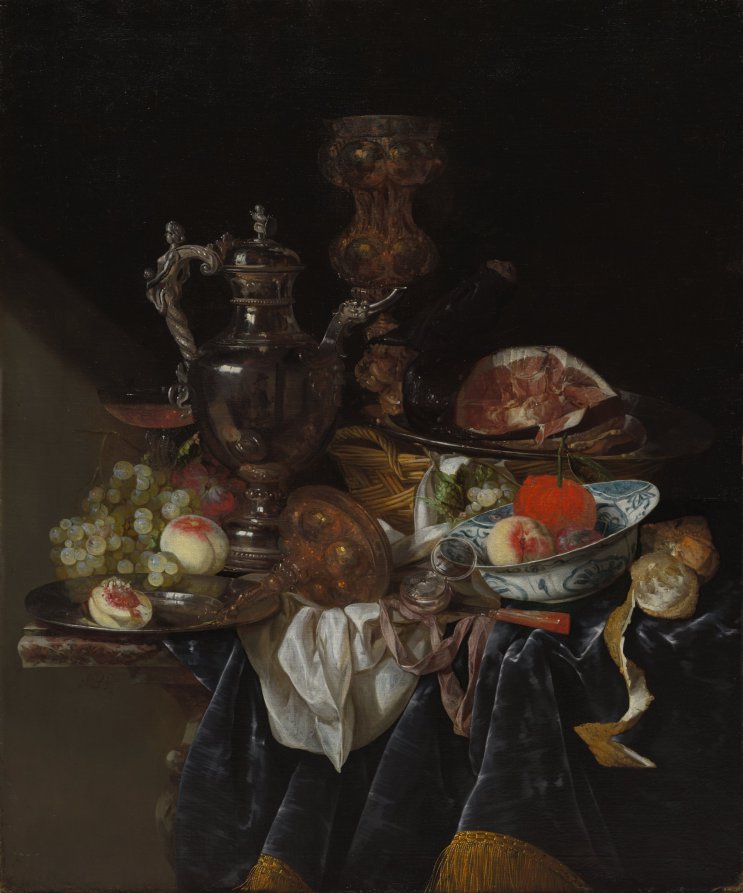
Geometric Integrity and the 2026 Executive Silhouette
The subject—a silver wine jug, ham, and fruit—presents a deceptive simplicity. At first glance, it is a still life of domestic abundance. However, a rigorous analysis of its geometric integrity reveals a profound architectural logic that directly informs the 2026 executive silhouette for Addison Fashion. This composition is not about organic plenitude; it is a study in controlled volume, axial tension, and the poetics of metallic compression. The silver wine jug, in particular, functions as the structural anchor, dictating a silhouette that is simultaneously rigid and fluid, a paradox resolved through tailored precision.Structural Poetics: The Jug as Architectural Fulcrum
The silver wine jug is the dominant vertical axis. Its form—a cylindrical body tapering to a narrow neck, with a pronounced spout and handle—establishes a clear hierarchy of volumes. The body’s polished silver surface reflects and distorts the surrounding space, creating a dialogue between solidity and illusion. This is not a soft, organic curve; it is a geometric arc, a segment of a perfect circle rendered in metal. The handle, a sweeping loop, introduces a counterpoint of tension, a dynamic line that breaks the static verticality. In the 2026 executive silhouette, this translates to a jacket with a defined, almost architectural shoulder—a sharp, tailored line that mimics the jug’s rigid neck—paired with a single, asymmetrical lapel that arcs like the handle, creating a visual counterbalance. The silhouette is compressed at the waist, echoing the jug’s narrowing, and flares subtly at the hip, a nod to the jug’s base. The materiality is key: the silver’s reflective quality is translated into a high-lustre wool gabardine, its surface catching light in sharp, angular planes.Urban Materiality: The Ham and Fruit as Textural Counterpoints
The ham and fruit are not passive objects; they are textural and volumetric foils to the jug’s metallic rigidity. The ham, with its marbled fat and dense flesh, introduces a soft, yielding mass. Its form is irregular, a biomorphic lump that resists geometric definition. This is the urban counterpoint—the organic chaos of the city, the unscripted moment. In the silhouette, this is expressed through a soft, unstructured trouser, cut from a heavy, matte wool crepe. The fabric drapes with a deliberate weight, creating a subtle, almost geological fold at the ankle. The fruit—apples, perhaps, or pears—are spheres and ovoids, perfect geometric solids rendered in organic matter. Their skins are taut, glossy, and colored in deep reds and greens. These are the punctuation marks of the composition. In the collection, they manifest as a single, oversized pocket, a structural pouch that disrupts the clean line of the jacket, or as a circular, polished metal button at the cuff. The fruit’s gloss is translated into a patent leather trim on the collar, a sharp, reflective edge that catches the urban light.Material Transfiguration: From Bronze to Silver, From Stone to Fabric
The internal DNA provided—the rock as fantastic mountain and the jar as bronze container—offers a critical lens. The rock is a microcosm, a “small seeing the large.” The jar is a cultural homage, a “form transposed.” Both are acts of material transfiguration. The silver wine jug is not merely a vessel; it is a translation of the bronze hu’s ritual authority into a modern, domestic context. The silver’s cool, reflective surface strips away the bronze’s historical patina, replacing it with a contemporary, urban sheen. The ham and fruit are not just food; they are the organic, the perishable, the “natural” that is tamed by the silver’s geometry. This is the core of the 2026 executive silhouette: a dialectic between the permanent and the ephemeral. The tailored jacket is the bronze hu—structured, authoritative, a carrier of cultural memory. The soft trouser is the rock—organic, irregular, a fragment of the natural world. The silver is the mediator, the urban material that binds them.Silhouette Construction: The Three-Zone System
The composition dictates a three-zone silhouette for the executive wardrobe. Zone One: The Upper Volume (The Jug) The jacket is the primary zone. It is a single-breasted, two-button model with a high, narrow gorge. The shoulder is a structured, slightly extended point, mimicking the jug’s spout. The sleeve head is high and crisp, creating a clean line from shoulder to cuff. The fabric is a silver-grey wool-mohair blend, its surface woven with a subtle, vertical rib that catches light like the jug’s polished metal. The lapel is a peak, but with a sharp, almost aggressive angle, a nod to the handle’s dynamic arc. The waist is suppressed, but not cinched; it is a geometric reduction, a precise narrowing that creates a clean, architectural V-shape. Zone Two: The Middle Volume (The Ham) The trouser is the middle zone. It is a high-waisted, straight-leg cut with a soft, unpressed crease. The fabric is a heavy, matte wool flannel in a deep, charcoal onyx. The volume is generous through the thigh, then tapers slightly to the ankle, creating a soft, columnar fall. The waistband is a single, wide piece of fabric, with no belt loops, emphasizing the clean, unbroken line. The ham’s irregular mass is translated into a deliberate, controlled fullness, a volume that is not flared but weighted, like a heavy drape. Zone Three: The Accent Points (The Fruit) The accessories are the accent points. A single, circular silver brooch at the lapel buttonhole, its surface polished to a mirror finish. A pair of leather gloves in a deep, oxblood red, the color of the apple skin, with a single, silver button at the wrist. The shoes are a derby boot in polished silver leather, with a chunky, geometric heel that echoes the jug’s base. These are not decorative; they are structural punctuations, the fruit’s gloss and color translated into urban materiality.Conclusion: The Urban Poetics of Controlled Volume
The 2026 executive silhouette, derived from this still life, is a study in controlled volume and material transfiguration. It rejects the soft, amorphous shapes of casual wear and the rigid, uniform lines of traditional suiting. Instead, it proposes a third way: a tailored structure that accommodates organic mass, a geometric precision that is softened by texture and weight. The silver wine jug is the anchor, the ham is the counterpoint, and the fruit is the accent. The result is a silhouette that is both authoritative and fluid, a reflection of the urban executive who navigates a world of hard edges and soft opportunities. It is a silhouette of silent power, where every line is a decision, every volume a negotiation. This is not a garment; it is an architectural proposition for the body in the city.
Technical Insight
Technical Insight: Translating Silver palettes into Tailored silhouettes for the modern metropolis.