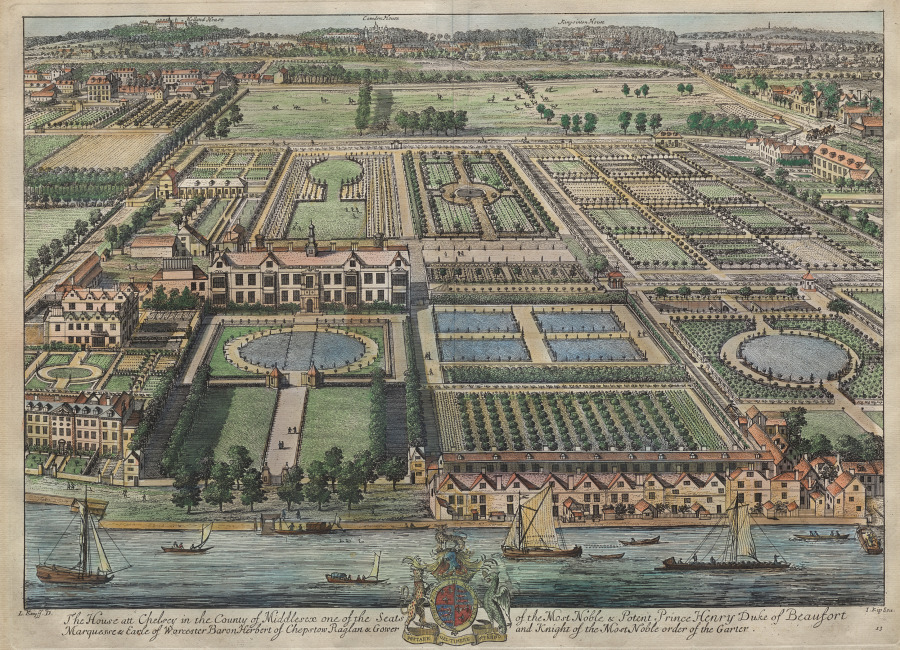
Urban Form: Beaufort House, Chelsea
Structural Poetics: The Architectural Dialogue of the Beaufort House Collection
The Beaufort House, Chelsea, serves as the spatial crucible for Addison Fashion’s 2026 Urban Silhouette Research. The internal DNA, drawn from the Bodhisattva and the Amulet in the Form of a Seated Figure with Bovine Head, presents a dialectic of sacred geometries that directly informs our forthcoming collection. These two artifacts—one a vessel of Buddhist compassion, the other a talisman of Egyptian protection—are not mere historical references but structural archetypes. Their formal languages, when decoded, yield a definitive blueprint for the executive silhouette: oversized, monolithic, and imbued with a cold, protective authority.
Geometric Integrity: The Bodhisattva’s Inner Void
The Bodhisattva’s seated posture—the padmasana or lalitasana—is a study in contained volume. The figure’s torso forms a stable, triangular mass, while the draped robes create cascading, asymmetrical planes that soften the underlying geometry. For the 2026 silhouette, we extract the principle of the inner void: the garment does not cling to the body but rather encloses space. The oversized coat becomes a mobile architecture, its shoulders broad and unyielding, its sleeves voluminous enough to suggest the infinite compassion of the Bodhisattva’s embrace. The fabric falls in controlled, weighted folds, echoing the sanghati (monastic robe) but rendered in urban materials—double-faced wool, bonded cashmere, and liquid matte nylon. The silhouette is not about the body’s contours but about the atmosphere it commands. The neckline remains high and enclosed, a nod to the meditative inward gaze, while the hemline drops to the ankle, grounding the wearer in a state of elevated stillness.
Geometric Integrity: The Bovine Amulet’s Monumental Mass
In stark contrast, the Amulet in the Form of a Seated Figure with Bovine Head presents a compressed, cubic mass. The bovine head, with its broad, horizontal horns, creates a lintel-like structure across the upper body. The seated figure is a block of pure presence—no drapery, no gesture, only the absolute geometry of protection. This translates directly into the 2026 silhouette’s shoulder architecture. We introduce the horned shoulder: a sharp, horizontal extension that mimics the amulet’s bovine crown. The jacket’s silhouette becomes a fortress—the shoulders squared and projecting, the chest panel flat and unyielding, the waist suppressed only minimally to suggest the seated stability of the amulet. The materiality shifts to armored textures: bonded leather, technical twill, and micro-ribbed neoprene. The color Onyx—a deep, absorbent black—unifies these elements, rendering the garment as a monolithic shadow against the urban landscape.
Urban Materiality: The Synthesis of Sacred and Secular
The 2026 executive silhouette is not a costume; it is a functional artifact for the city. The Bodhisattva’s compassionate volume and the amulet’s protective mass are synthesized through material innovation. We employ structural bonding to create seams that hold their shape without internal padding—a technique borrowed from architectural membrane construction. The oversized coat’s sleeves are cut with a negative ease at the armhole, allowing the fabric to stand away from the body, creating a breathing void that echoes the Bodhisattva’s inner space. The jacket’s shoulders are reinforced with a carbon-fiber interlining, invisible to the eye but palpable in the garment’s uncompromising stance.
The color palette is deliberately austere. Onyx serves as the foundational hue—a black that absorbs light rather than reflecting it, suggesting both the void of meditation and the impenetrability of the amulet. Accents of Slate and Silver appear in the form of geometric stitching—linear patterns that map the energy lines of the Bodhisattva’s mudras and the amulet’s hieratic symmetry. These are not decorative; they are structural cartography, guiding the eye across the garment’s surface as one would trace the contours of a sacred object.
The 2026 Executive Silhouette: A Definitive Statement
The final silhouette is defined by three key proportions:
1. The Over-Scaled Torso: The coat or jacket extends beyond the body’s natural width by 15–20 cm at the shoulders, creating a protective canopy. The chest is flat and broad, with no darts or shaping, referencing the amulet’s cubic stability. The waist is defined only by a subtle inward curve at the side seams, suggesting the Bodhisattva’s seated composure.
2. The Vertical Cascade: From the shoulder’s apex, the fabric falls in a single, unbroken line to the hem. This is achieved through a gravity-weighted construction: the hem is lined with a fine metal chain, ensuring the garment hangs with monumental stillness. The effect is that of a sacred curtain or a processional robe, but rendered in urban fabrics that resist wind and rain.
3. The Enclosed Neck: The collar rises to the jawline, forming a continuous loop that frames the face. This is a direct translation of the amulet’s protective enclosure and the Bodhisattva’s inward focus. The collar is cut from a single piece of fabric, with no visible seam, reinforcing the monolithic integrity of the silhouette.
Conclusion: The Urban Bodhisattva
The Beaufort House Research yields a silhouette that is both sacred and strategic. The 2026 executive is not merely dressed; she is enshrined within a garment that functions as a mobile sanctuary. The oversized proportions do not overwhelm but rather command space, while the Onyx palette absorbs the chaos of the city into a singular, meditative presence. This is the urban Bodhisattva—compassionate in her stillness, protective in her mass, and absolute in her geometry. The silhouette is a prayer in fabric, a talisman in tailoring, and the definitive statement for the executive who moves through the metropolis as a living artifact of power and grace.