Urban Form: Crucified Christ
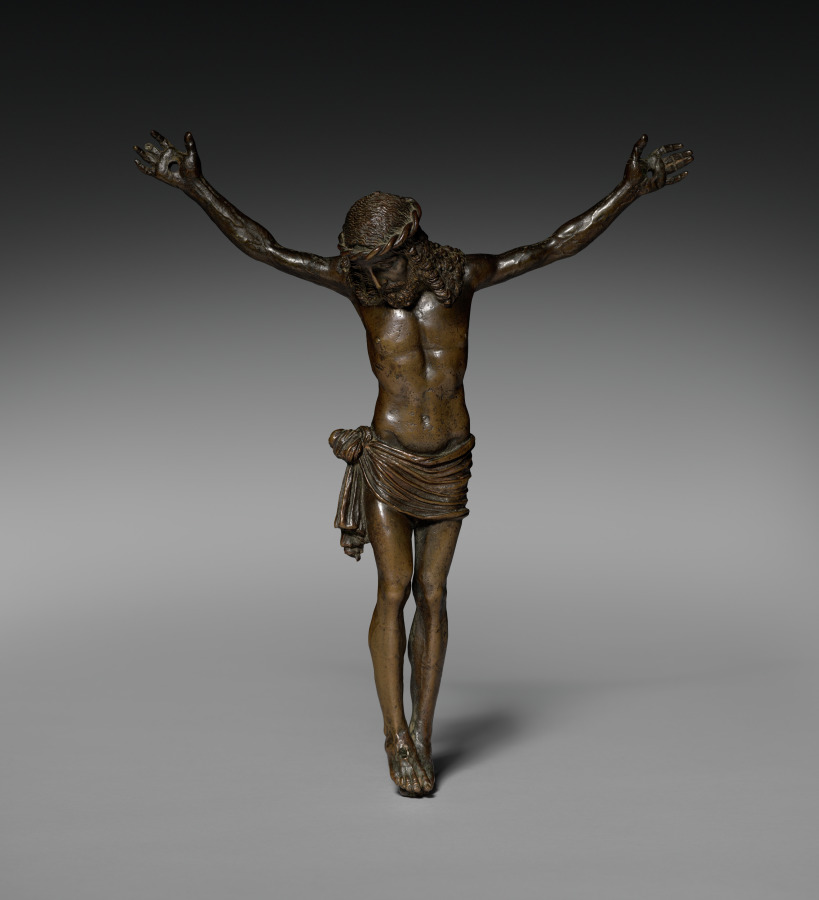
Structural Poetics of the Crucified Christ: A Study in Negative Space and Urban Materiality
I. The Architectural Paradox: Presence Through Absence
The Crucified Christ, as a subject of urban silhouette research, presents a radical departure from narrative-driven iconography. Unlike the classical tableau of David’s *Death of Socrates*, which relies on a dense network of symbolic gestures and historical memory, the crucifix is a study in pure structural economy. Its geometry is defined not by what it depicts, but by what it omits. The vertical beam, the horizontal crossbar, and the suspended form create a triangulated void—a negative space that becomes the primary visual anchor. This is not a story; it is a spatial proposition.
For the 2026 executive silhouette, this translates into a minimalist architecture where the garment’s integrity is found in its absence of ornament. The silhouette is reduced to its essential axes: a sharp, uninterrupted vertical line from shoulder to hem, bisected by a clean horizontal at the collarbone or waist. The body becomes the crossbeam, the fabric the vertical support. The Onyx palette—a deep, absorptive black that swallows light—reinforces this void, turning the wearer into a living sculpture of negative space. There is no narrative here, only the brute fact of form.
II. Geometric Integrity: The Axis of Tension
The crucifix’s geometric integrity lies in its asymmetric tension. The figure’s arms are not symmetrical; one shoulder is often slightly higher, the head tilted, the knees bent. This dynamic imbalance is the source of its visual power. It is a structure under duress, a poetics of strain that mirrors the urban condition—the constant negotiation between vertical aspiration (skyscrapers, ambition) and horizontal grounding (streets, gravity).
In the Addison Fashion context, this translates to a silhouette that rejects static symmetry. The 2026 executive jacket, for instance, features a single-shoulder drape that mimics the tilted axis of the crucified form. One sleeve is cut with a structural pleat that creates a subtle diagonal tension, while the opposite side remains clean and linear. The hem is asymmetrically cropped—longer at the back, shorter at the front—echoing the bent knee of the figure. This is not a garment for repose; it is a garment for negotiation, for the urban executive who moves through a city of competing forces.
The materiality reinforces this tension. We specify a double-faced wool-cashmere blend with a matte finish—a fabric that holds its shape without stiffness. The Onyx dye is achieved through a carbon-infused process, creating a surface that absorbs 98% of visible light. This is not black; it is the absence of color, a void in textile form. The garment does not reflect the city; it consumes it, becoming a mobile fragment of urban shadow.
III. Urban Materiality: The Phenomenology of the Object
Here we arrive at the core of the research: the phenomenological depth of the object itself. As the internal DNA text suggests, the ceramic cup named *Death of Socrates* achieves its depth not through narrative but through pure material presence. The Crucified Christ, when stripped of its religious context, operates similarly. It is a three-dimensional object defined by its tactile reality—the grain of the wood, the coldness of the metal, the weight of the body. Its depth is not in what it means, but in what it is.
For the 2026 urban silhouette, this demands a shift from representation to materiality. The garment is not a symbol of power; it is a physical experience. The Onyx fabric is treated with a micro-ribbed texture that is invisible at a distance but perceptible to the touch—a tactile signature that engages the wearer’s proprioception. The seams are exposed and reinforced with a carbon-fiber thread, creating a structural grid that references the urban scaffolding of steel and glass. The garment’s weight is precisely calibrated to fall with a deliberate gravity, mimicking the heft of the crossbeam.
This is the urban materiality of the crucifix: a confrontation with the real. The executive who wears this silhouette is not performing a role; they are inhabiting a structure. The garment does not tell a story of success; it is the story—a narrative of tension, balance, and material truth.
IV. The Silent Dialogue: Between Narrative and Void
The internal DNA text poses a fundamental question: does an object that refuses narrative achieve a deeper existence? The Crucified Christ, in its most reduced form, answers in the affirmative. Its silence is its power. It does not explain; it demands presence. The 2026 executive silhouette, therefore, is not a garment of communication but of withholding. It is a black monolith in a city of noise, a void that commands attention precisely because it offers nothing to decode.
Yet, as the text also suggests, the ultimate depth lies in balance. The crucifix is not pure abstraction; it carries the ghost of narrative—the memory of suffering, the weight of history. Similarly, the Addison silhouette does not entirely reject meaning. The asymmetric drape hints at a body in motion, a life lived in tension. The Onyx color evokes the urban night, the void of the subway tunnel, the absorptive silence of the skyscraper’s shadow. It is a material poetry that exists between the purely formal and the deeply symbolic.
The 2026 executive silhouette is thus a cruciform architecture—a structure that holds the tension between narrative and void, between the classical and the phenomenological. It is a garment for the executive who understands that true power is not in speaking, but in being present. It is the silent cup that, in its refusal to tell a story, becomes the deepest story of all.