Fluid
Slate
Urban Form: Seated Buddha (sculpture)
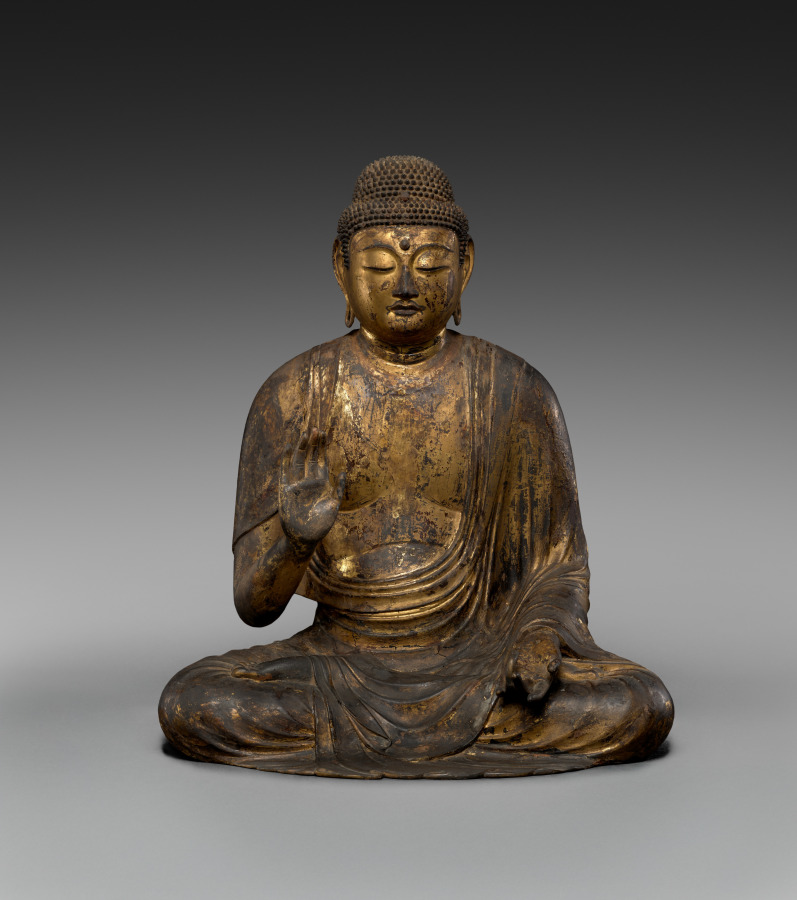
Technical Deconstruction: The Seated Buddha as a Study in Volumetric Stillness
The Seated Buddha, in its canonical sculptural form, presents a paradox of mass and immateriality. Unlike the Western sculptural tradition’s emphasis on muscular tension and narrative action—as seen in the *The Agony in the Garden*’s anatomical precision—the Buddha figure operates through a principle of **compressed gravity**. The form is not a body in crisis but a body in equilibrium. For the 2026 NYC executive wardrobe, this translates into a critical interrogation of how volume can signal authority without aggression, and how stillness can project power without stasis.Formal Analysis: The Architecture of the Lotus Position
The seated posture—the *padmasana*—is a closed system. The legs are interlocked, creating a triangular base that anchors the figure to the earth. This is not a pose of readiness or flight; it is a pose of **rooted permanence**. The knees, often broad and rounded, form the widest points of the silhouette, while the torso tapers upward toward the shoulders. The spine is elongated but not rigid, creating a subtle S-curve that introduces a dynamic counterpoint to the geometric stability of the base. From a tailoring perspective, this is a masterclass in **negative space management**. The folds of the robe—the *sanghati*—are not arbitrary drapery. They follow a strict logic of radial compression. The fabric gathers at the left shoulder, cascading in parallel ridges that echo the verticality of the spine, then breaks over the right shoulder in a series of softer, diagonal pleats. This asymmetry is deliberate: it creates a visual rhythm that prevents the form from becoming a monolithic block. The folds are not decorative; they are structural, channeling the eye downward and inward, toward the center of gravity—the *hara* or energy point just below the navel. For the executive wardrobe, this suggests a radical rethinking of the **jacket silhouette**. The traditional power shoulder—broad, padded, aggressive—is replaced by a **dropped shoulder with a soft, rounded cap**. The sleeve head is unpadded, allowing the fabric to fall in a continuous line from the neck to the wrist. The chest is not suppressed; instead, the garment is cut with a **slight A-line from the underarm**, creating a gentle, bell-like volume that mimics the Buddha’s torso. The waist is not cinched but hinted at through the internal structure of the canvas, which is fused with a lightweight, non-woven interlining to maintain shape without rigidity. The pant, correspondingly, adopts a **wide, straight leg** that falls from the hip without break. The front is flat, with no pleats, to preserve the clean line of the thigh. The back, however, incorporates a **single, deep fisheye dart** at the knee, which allows the fabric to wrap around the calf without excess. This is a direct translation of the Buddha’s robe fold: the fabric is allowed to pool at the ankle, creating a slight, deliberate break that echoes the drapery’s terminal point at the feet.Color and Material: The Slate Spectrum
The color **Slate** is not a neutral; it is a **chromatic field of tension**. It sits between charcoal and blue-gray, absorbing light rather than reflecting it. In the context of the Buddha sculpture, the original material—often black stone, bronze, or dark wood—absorbs ambient light, creating a surface that is both solid and void-like. The *patina* of age adds a micro-texture of irregular highlights, a phenomenon we replicate through **slubbed wool** or **worsted flannel with a subtle herringbone weave**. The palette for this capsule is restricted to three tones: **Deep Slate** (the primary), **Mid Slate** (the secondary), and **Smoke** (a pale, almost white gray for contrast). The Deep Slate serves as the anchor—the jacket, the trousers, the coat. The Mid Slate appears in the layering piece: a **high-neck vest** or a **sleeveless shell** cut from a **double-faced cashmere**. The Smoke is reserved for the shirt, a **poplin with a matte finish** that provides a crisp, luminous counterpoint to the matte density of the outer layers.Deconstructing the “Vaporous Contour”
The second DNA source—*Below, I Saw the Vaporous Contours of a Human Form*—introduces a critical counter-narrative. Where the Buddha is solid, this form is **dissolving**. The “vaporous contour” is not a silhouette but a **boundary condition**. It suggests a garment that is not a second skin but a **field of presence**. This is achieved through **unstructured construction**. The jacket is unlined, with raw edges at the armhole and hem. The shoulder seam is left exposed, with a **visible, hand-finished fell stitch** that reads as both deliberate and fragile. The fabric—a **worsted wool-cashmere blend in 180s weight**—is cut on the bias for the sleeves, allowing them to drape with a liquid, almost gravitational pull. The front closure is not a button but a **single, hidden magnetic snap** at the sternum, allowing the jacket to fall open or closed without visible hardware. The pant, in this iteration, is a **wide-leg culotte** cut from a **silk-wool crepe**. The fabric is so light that it moves with the air, creating a “vaporous” hem that shifts with each step. The waistband is elasticated at the back, with a flat front and a **single, side-seam pocket** that is cut on the curve of the hip. The pocket opening is finished with a **hand-rolled edge**, a detail that is invisible from a distance but tactile upon close inspection.Integration: The 2026 Executive Silhouette
The final silhouette is a **layered system of compression and release**. The base layer is the Smoke shirt, cut with a **mandarin collar** that stands away from the neck by 1.5 cm, creating a void between fabric and skin. Over this, the Mid Slate vest—a **sleeveless, high-neck garment** with a **center-back seam** that traces the spine—acts as a second, more intimate layer. The vest is cut with **no side seams**, using a **single piece of fabric** that wraps from front to back, creating a continuous, unbroken line around the torso. The outer layer is the Deep Slate jacket, cut with the **dropped shoulder and A-line body** described above. The jacket is worn open, revealing the vest and the shirt’s collar. The trousers—either the straight-leg or the culotte—are chosen based on the day’s context: the straight-leg for boardroom authority, the culotte for creative strategy sessions. The **critical detail** is the **hem of the jacket**. It falls at the **mid-thigh**, a length that is neither short nor long. This creates a **horizontal line** that bisects the verticality of the silhouette, echoing the Buddha’s knee line. The hem is **unfinished**, left as a raw edge that will fray slightly over time, introducing a micro-texture of wear that personalizes the garment.Conclusion: The Aesthetics of Controlled Dissolution
The Seated Buddha and the vaporous contour are not opposites; they are **two states of the same material reality**. The Buddha’s solidity is a **temporary crystallization** of energy, just as the vapor is a **dissipation of form**. The 2026 executive wardrobe must operate within this spectrum: it must provide the **structural authority** of the seated figure while allowing for the **fluidity and ambiguity** of the modern self. The Slate palette, with its absorption of light, becomes the **visual equivalent of this dual state**. It is a color that does not declare but **suggests**. It is the color of stone and of smoke, of the permanent and the ephemeral. The garments, cut with precision but finished with intentional imperfection, become **instruments of presence**—not armor, but **atmosphere**. The final result is a wardrobe that does not demand attention but **commands it through absence**. It is the silhouette of a figure who is both seated and in motion, both solid and dissolving, both here and elsewhere. This is the urban poetry of the 2026 executive: a body that is both a monument and a vapor.
Technical Insight
NYC Perspective: Translating Slate tones into Fluid silhouettes.