Tailored
Onyx
Urban Form: Italian Sketchbook: Abstract Sketch (page 5)
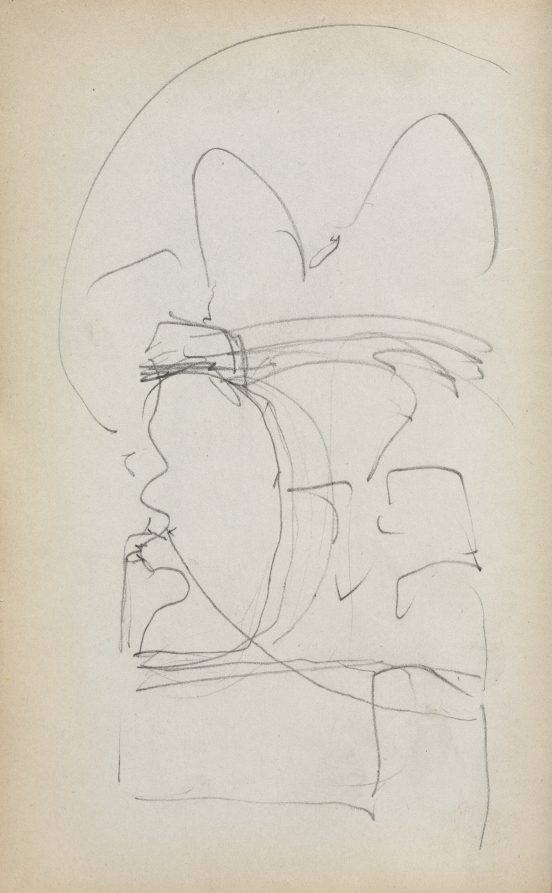
Geometric Integrity as Architectural Narrative
The Italian Sketchbook: Abstract Sketch (page 5) presents a study in controlled asymmetry—a deliberate departure from the rigid bilateral symmetry of the *Textile with crowned double-headed eagles* yet retaining its foundational logic of hierarchical order. The sketch’s line work suggests a fragmented, exploded view of a garment’s internal structure: seams become vectors, darts become acute angles, and the negative space between them is treated as a volumetric void rather than mere background. This is not a decorative pattern; it is a blueprint for a three-dimensional architectural shell. The geometric integrity of this artwork is defined by its **tension between the orthogonal and the diagonal**. Vertical lines—reminiscent of the warp threads in the sixteenth-century textile—anchor the composition with a sense of gravitational pull. Horizontal bands, perhaps referencing the layered registers of the Japanese *Screen with European Figures*, provide a stabilizing datum. Yet the dominant force is the diagonal: a series of sharp, intersecting lines that cut across the field like structural trusses. These diagonals do not merely decorate; they **generate volume**. They imply a folding of the plane, a pleating of the surface, a compression of space that must be resolved into a three-dimensional form. This is the core of the 2026 executive silhouette: **the tailored shell as a resolved conflict**. The garment is not draped; it is constructed. It does not flow; it articulates. The sketch teaches us that the most powerful silhouette is one that acknowledges the forces acting upon it—gravity, movement, the body’s own geometry—and then **disciplines them into a state of poised tension**. The double-headed eagle’s symmetrical authority is internalized, not displayed. The screen’s curious translation of the foreign is refined into a pure, abstract language of line and plane.Structural Poetics: The Seam as a Line of Force
The sketch’s most radical proposition is the **elevation of the seam from a functional necessity to a primary aesthetic element**. In the *Textile with crowned double-headed eagles*, the pattern is woven into the fabric itself; the structure is the decoration. In the *Screen with European Figures*, the gold-leaf clouds and outlined figures are painted *onto* the surface. The Italian Sketchbook, however, treats the seam as a **line of force** that both divides and unites the garment’s surface. For the 2026 executive silhouette, this translates into a **radical rethinking of the shoulder and torso**. The traditional shoulder seam is no longer a simple horizontal line. Instead, it becomes a **diagonal vector** that originates at the base of the neck and terminates at the outer edge of the deltoid, creating a sharp, almost architectural cantilever. This is not a natural shoulder; it is a **constructed shoulder**, a structural event that announces the garment’s engineered nature. The waist is similarly redefined. The sketch suggests a **series of vertical darts that are not tapered to a point but are left open**, creating a subtle, linear relief on the fabric’s surface. These are not darts that disappear; they are **sculptural grooves** that channel the eye downward, elongating the torso and creating a sense of vertical compression. The result is a silhouette that is **narrow, columnar, and emphatically vertical**, yet with a palpable internal structure that prevents it from being merely severe. The poetics of this structure lie in its **silent authority**. Unlike the overt power of the double-headed eagle, this is a power that is **internalized, rationalized, and expressed through pure geometry**. The wearer does not display a symbol of power; they *embody* a system of structural logic. The garment becomes a second skeleton, a **exoskeleton of tailored precision**.Urban Materiality: Onyx as the New Neutral
The chosen color, Onyx, is not arbitrary. It is the **chromatic equivalent of the sketch’s geometric tension**. Onyx is not black; it is a **deep, compressed darkness** that absorbs light rather than reflecting it. It possesses a **mineral density** that aligns perfectly with the architectural ambitions of the silhouette. In the context of the *Textile with crowned double-headed eagles*, Onyx replaces the deep indigo or crimson ground, stripping away the heraldic color and leaving only the **structural logic of the gold thread**. The gold is gone; the *structure* remains. In the context of the *Screen with European Figures*, Onyx replaces the gold-leaf background. The screen’s luminous, reflective surface is inverted into a **matte, light-absorbing void**. The European figures are no longer depicted; their **structural essence**—the verticality of their posture, the angularity of their clothing—is abstracted into the garment’s seams and planes. The materiality of the 2026 executive silhouette, therefore, is one of **controlled opacity**. The fabrics will be dense, tightly woven, and possess a **crisp, almost papery hand**—reminiscent of the sketch’s own paper support. Wool crepe, high-twist gabardine, and compacted cotton sateen are the primary candidates. These materials do not drape; they **hold a crease**. They do not flow; they **stand in space**. Surface treatment is minimal. The Onyx ground is **unadorned**, save for the **structural lines** created by the seams and darts. There is no embroidery, no print, no appliqué. The only texture is the **subtle ribbing of the fabric’s weave** and the **sharp, clean edge of the seam allowance**. This is a **material asceticism** that elevates the garment’s architectural logic above all else.Conclusion: The Silhouette as a Statement of Resolved Complexity
The 2026 executive silhouette, derived from the Italian Sketchbook, is not a nostalgic revival of the sixteenth-century textile or the seventeenth-century screen. It is a **synthesis of their underlying principles**: the textile’s **structural authority** and the screen’s **translational curiosity**. The result is a **tailored shell** that is both **rigorous and poetic**, both **urban and abstract**. The silhouette is **narrow at the shoulder, defined at the waist, and clean at the hem**. The jacket is **single-breasted, with a high, notched lapel that terminates in a sharp point**. The sleeve is **set in with a pronounced, diagonal seam** that creates a subtle, architectural cap. The trousers are **straight, with a single, vertical crease that aligns with the body’s center line**. The entire ensemble is **monochromatic in Onyx**, with the only variation being the **play of light across the seams and darts**. This is a silhouette for the executive who understands that **power is not displayed but embodied**. It is a silhouette for the urban environment, where the **geometry of the built world**—the sharp angles of skyscrapers, the orthogonal grid of streets, the diagonal cuts of bridges—is **internalized and refined into a personal aesthetic**. It is a silhouette of **resolved complexity**, a testament to the enduring power of **structural poetics** in an age of visual noise.
Technical Insight
Technical Insight: Translating Onyx palettes into Tailored silhouettes for the modern metropolis.