Urban Form: Seated Amitayus Buddha
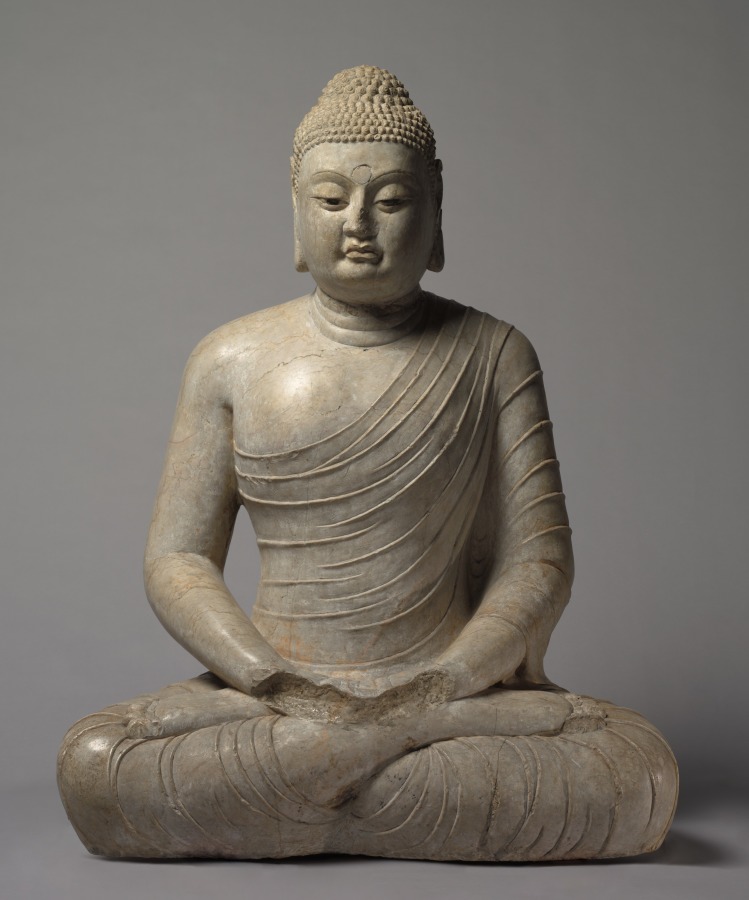
Geometric Integrity: The Architecture of the Seated Amitayus
The Seated Amitayus Buddha presents a paradigm of geometric stasis that directly informs the 2026 executive silhouette for Addison Fashion. The figure’s posture—a rigidly symmetrical, cross-legged foundation with a vertical, unwavering torso—establishes a primary structural vocabulary of axial alignment and planar reduction. The lotus pedestal functions as a pure, circular base, a geometric anchor from which all vertical lines ascend. The hands, held in the dhyana mudra, create a contained, elliptical void within the lap, a negative space that is as structurally significant as the positive mass of the shoulders. This is not a silhouette of motion, but of compressed potential. The drapery, rendered in flowing yet disciplined folds, is reduced to a series of parallel, vertical striations that cling to the body’s core, eliminating any suggestion of volume or excess. The head, with its ushnisha (cranial protuberance), forms a perfect, elongated dome, a terminal point that terminates the vertical thrust without ornament. The entire composition is a study in controlled mass—a block of materiality that has been carved down to its essential, meditative core.
Structural Poetics: From Sacred Stasis to Urban Armor
The translation of this sacred geometry into an executive silhouette requires a rigorous abstraction. The Buddha’s immutable posture becomes the blueprint for a garment that imposes order upon the wearer’s body. The cross-legged base, a symbol of groundedness, is reinterpreted as a wide, stable hemline in a floor-length coat or a sharply tailored, A-line skirt that anchors the figure to the ground. The vertical drapery lines are not decorative; they are structural seams that guide the eye upward, elongating the torso and creating a sense of unbroken, vertical flow. The dhyana mudra’s elliptical void is translated into a negative-space cutout at the waist or a sculpted, armhole that frames the torso without constriction. The ushnisha’s dome is echoed in a high, clean collar or a minimal, architectural hood that frames the face, drawing attention to the head as the seat of intellect and authority. The overall effect is one of armored stillness—a garment that does not move with the body but rather holds the body in a state of composed, deliberate presence. The silhouette is not soft; it is carved. It is a shell of urban poetics, a wearable meditation on permanence within the transient city.
Urban Materiality: The Dialectic of Udumbara and The Hunt
The internal DNA of the Udumbara flower and The Hunt provides the material and textural dialectic for this silhouette. The Udumbara, a symbol of rare, ephemeral purity, dictates a surface of extreme refinement. The primary material must be Ivory—not a warm cream, but a cold, architectural white that absorbs and reflects light with equal indifference. This is achieved through a double-faced wool crepe or a matte, liquid-like satin that holds a sharp crease without any sheen. The surface is unadorned, a blank canvas that invites contemplation. The texture is the geometry: the fabric’s weave is so tight it becomes a second skin of structure, a membrane that denies the chaos of the street. This is the Udumbara’s “存有之无”—a presence that is felt through its absence of ornament.
Conversely, The Hunt’s “存在之烈” is not expressed through overt violence but through structural tension and hidden restraint. The garment’s interior construction must be a corset of architectural boning, not to cinch the waist, but to maintain the silhouette’s rigid, vertical axis against the body’s natural curve. The seams are not sewn; they are welded or bonded, creating a seamless, monolithic surface that is as hard as a sculpture. The closure is a concealed, magnetic placket, a silent, predatory mechanism that holds the garment together with invisible force. The fabric itself is a composite: a base of the purest wool, bonded to a layer of micro-perforated leather that is visible only at the edges of the cutouts. This leather, dyed a deep, almost-black Onyx, is the ghost of The Hunt—a reminder of the flesh and struggle that exists beneath the serene surface. The garment’s weight is its power; it is heavy, substantial, and demands the wearer to move with intention. The urban materiality is one of controlled aggression: a pristine, white exterior that conceals a dark, structural core.
The 2026 Executive Silhouette: A Synthesis of Opposites
The definitive 2026 executive silhouette, born from this analysis, is a Minimalist Armor in Ivory. It is a single, unbroken line from shoulder to hem, with a high, closed neckline and a floor-grazing length. The shoulders are sharp and defined, but not exaggerated—they are the precise width of the Buddha’s shoulders, a geometry of balance. The sleeves are set-in and slim, ending at the wrist bone, exposing the hands as the only points of organic movement. The garment’s only detail is a single, vertical seam that runs from the center of the collarbone down the front, a reference to the Buddha’s central axis. This seam is not stitched; it is a laser-cut, bonded edge that creates a hairline fracture in the ivory surface, a subtle, structural scar. The back is a single, uninterrupted plane of fabric, a monolithic shield against the city’s chaos. This is not a garment for the timid. It is a statement of presence, a wearable meditation on the tension between the ephemeral (Udumbara) and the eternal (Amitayus), between the serene and the predatory (The Hunt). It is the silhouette of an executive who commands not through movement, but through the absolute stillness of their form.