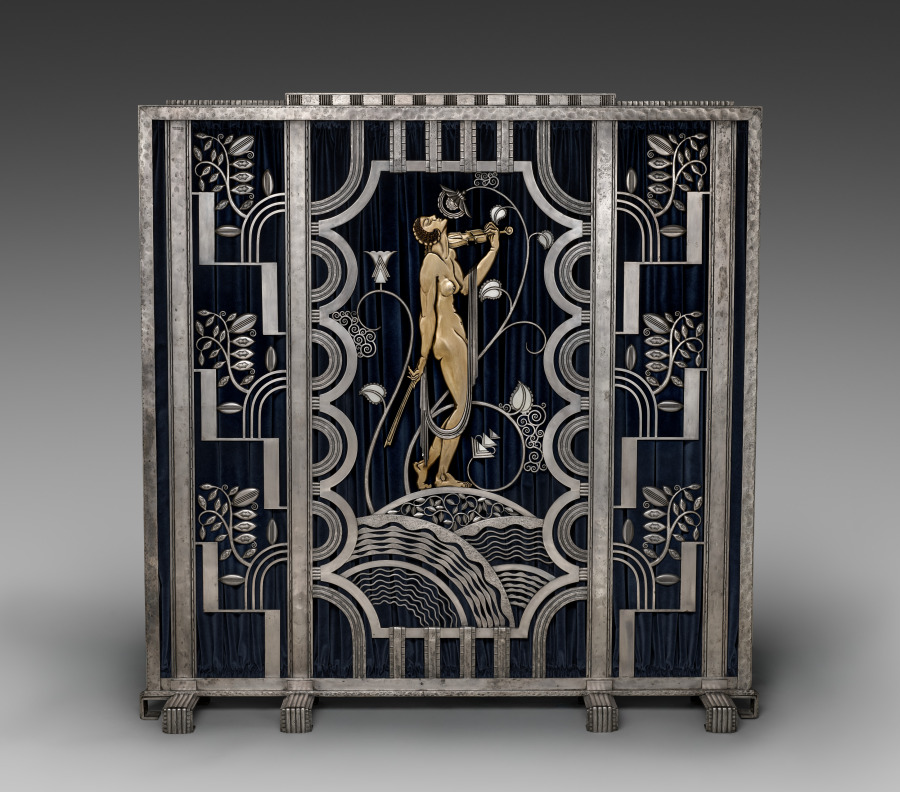
Urban Form: Muse with Violin Screen
Executive Summary: The Dialectic of Form in the 2026 Urban Silhouette
The subject, Muse with Violin Screen, presents a compelling dualism that directly informs the Addison Fashion NYC Spring/Summer 2026 collection. The visual and conceptual DNA, drawn from the juxtaposition of a Bodhisattva and a Bovine-Head Amulet, establishes a new paradigm for the executive wardrobe. This is not a binary choice between softness and strength, but a sophisticated synthesis: the Bodhisattva represents the expansive, compassionate, and public-facing ideal of leadership, while the Amulet embodies the compressed, protective, and private armor of the individual. The resulting silhouette is a study in controlled tension—a minimalist architecture that oscillates between serene volume and concentrated power. The chosen palette of Onyx anchors this dialectic, providing a chromatic void where form and shadow become the primary communicators of status and intent.
I. Form Analysis: The Architecture of Compassion and Protection
A. The Bodhisattva Silhouette: Expansive Grace and Fluid Linearity
The Bodhisattva archetype dictates a silhouette of unfurled generosity. Its aesthetic is characterized by a vertical, flowing line that suggests both movement and stillness—a paradox essential for the modern executive navigating a fluid power structure. The key formal elements are:
- Draped Volumes: Fabrics are not cut to constrict but to cascade. Think of a double-faced wool coat with a bias-cut back panel that falls from the shoulder blades like a waterfall, creating a train of fabric that moves with the wearer, not against them. This is not a cape, but a structured drape—a controlled release of material that implies authority without rigidity.
- Asymmetric Closures: The traditional center-front button is eschewed in favor of a single, off-center closure at the collarbone or a hidden magnetic seam. This creates a subtle, asymmetrical neckline that echoes the gentle tilt of a Bodhisattva’s head, introducing a note of contemplative asymmetry into an otherwise linear form.
- Extended Shoulder Lines: The shoulder is not padded in the traditional power-suit sense. Instead, the seam is dropped 1.5 inches beyond the natural shoulder, creating a soft, rounded cap that extends the horizontal line. This extended shoulder provides a canopy of presence, a visual shelter for the wearer, without the aggressive angularity of a 1980s silhouette.
- Monochromatic Layering: The Bodhisattva’s layered robes are translated into tonal layering of Onyx—a silk georgette shell beneath a matte crepe blazer, beneath a cashmere-blend overcoat. Each layer is a slightly different weight and finish, creating a subtle depth that reads as quiet luxury, not bulk.
B. The Amulet Silhouette: Compressed Power and Geometric Armature
In direct opposition, the Bovine-Head Amulet informs a silhouette of concentrated density. This is the inner layer—the protective shell that the executive wears against the body. Its formal language is one of containment, precision, and latent force. Key elements include:
- High, Structured Necklines: The neck is a site of vulnerability. The Amulet archetype demands a mandarin collar or a stand-up funnel neck in a rigid fabric like bonded leather or a dense neoprene. This collar acts as a physical and psychological barrier, a ring of protection that frames the face with authority.
- Compressed Waistlines: Where the Bodhisattva flows, the Amulet cinches. A corseted waistband or a wide, structured belt in polished Onyx hardware is used to compress the torso. This creates a distinct hourglass or inverted-triangle silhouette, a visual compression that suggests immense stored energy. The waist is not a point of softness but a fulcrum of power.
- Geometric Cutouts and Seaming: The Bovine head’s angular features are translated into sharp, architectural seaming. A blazer might feature a laser-cut, geometric panel at the sternum or a sharp, angular dart that runs from the shoulder to the hip. These are not decorative; they are structural, creating a second-skin exoskeleton over the softer Bodhisattva layers.
- Shortened Hemlines and Cuffs: The Amulet’s power is in its concentration. Sleeves are cropped to the forearm, trousers are hemmed to the ankle, and jackets end at the natural waist. This truncated silhouette exposes the wrist and ankle—the points of articulation—suggesting readiness and action, not static contemplation.
II. Color Analysis: Onyx as the Chromatic Void
The selection of Onyx is not a default choice but a strategic one. It is the color of the void between the Bodhisattva’s compassion and the Amulet’s protection. It is not black; it is Onyx—a deep, geological black with a subtle, internal luminosity. It functions as a chromatic anchor for the entire collection.
- Absorption of Light: Onyx absorbs ambient light, creating a negative space around the wearer. This forces the eye to focus on the silhouette and texture rather than color. In a boardroom, this is a power move: the wearer becomes a sculptural presence, not a chromatic distraction.
- Textural Differentiation: The entire palette is monochromatic, so the surface finish becomes the primary differentiator. A matte, sand-washed silk shell (Bodhisattva) is layered beneath a high-gloss, patent leather corset (Amulet). The contrast between the matte and sheen within the same Onyx hue creates a visual tension that is both sophisticated and aggressive.
- Shadow as Form: Onyx allows for the manipulation of shadow. Deep pleats, inverted box pleats, and hidden pockets are not visible as color changes but as shifts in light and shadow. This creates a dynamic, living garment that changes with the wearer’s movement, revealing the internal architecture of the piece only in motion.
- Psychological Weight: Onyx carries the psychological weight of authority, finality, and protection. It is the color of the night sky and the deep earth. It is the visual equivalent of the Amulet’s protective function, while its subtle depth allows for the Bodhisattva’s contemplative stillness. It is the only color that can contain both extremes.
III. Synthesis: The 2026 Executive Wardrobe
The final silhouette for the Addison Fashion NYC executive is a layered dialectic. The outer layer is the Bodhisattva—a long, fluid, asymmetric coat in matte Onyx wool, with an extended shoulder and a single, hidden closure. Beneath it is the Amulet—a high-necked, corseted shell in polished Onyx leather, with geometric seaming and a compressed waist. The trousers are a hybrid: wide-legged and flowing from the hip (Bodhisattva), but cropped at the ankle and finished with a sharp, internal cuff (Amulet).
This is not a costume. It is a functional armor for the 2026 executive. The wearer can choose to present the compassionate, expansive Bodhisattva to the world, or, by removing the outer coat, reveal the concentrated, protective Amulet beneath. The wardrobe is a tool for psychological and social navigation, allowing the wearer to modulate their presence from open and receptive to closed and powerful, all within the same chromatic and formal language. The Muse with Violin Screen is not a passive figure; she is a conductor of these forces, using form and color to compose her own authority in a world of constant flux.