Minimalist
Slate
Urban Form: Church Bells Ringing, Rainy Winter Night
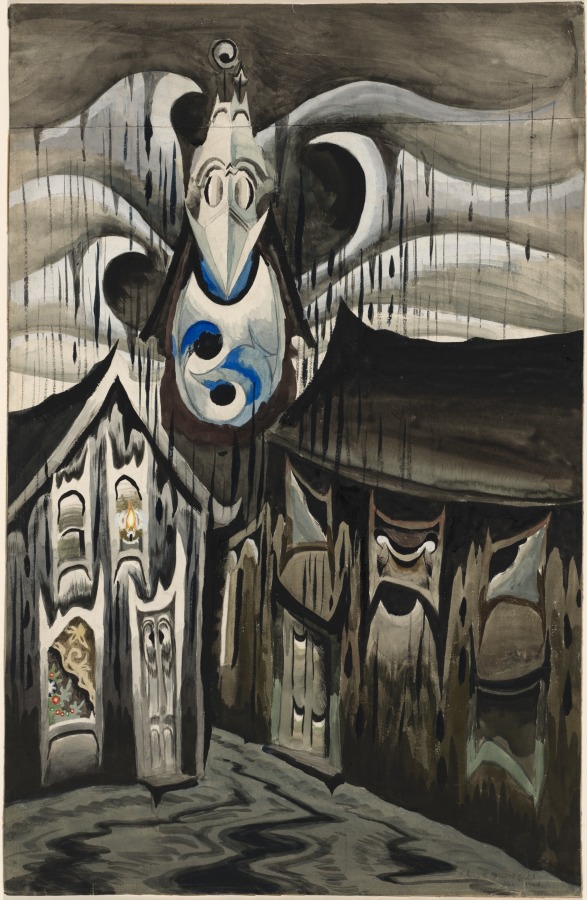
Form and Atmosphere: The Architectural Deconstruction of a Rainy Winter Night
The subject, *Church Bells Ringing, Rainy Winter Night*, presents a paradox of sensory input: the hard, resonant, vertical strike of metal against air, contrasted with the soft, horizontal, diffuse wash of water on glass. For the 2026 NYC executive wardrobe, this is not a mood board of nostalgia. It is a structural brief. The silhouette must reconcile the *percussive* with the *permeable*. The form is not about warmth or comfort in the traditional sense; it is about *containment* and *resonance* within a hostile, wet environment. The primary formal challenge is the management of volume. A rainy winter night in Manhattan is a study in negative space—the city’s hard edges are blurred, reflections multiply, and the human figure becomes a solitary, moving mass. The silhouette must therefore be a *monolith*. We reject the puffy, down-filled anorak as a failure of form. It is a concession to utility that destroys the line. Instead, we look to the *Pair of Roundback Armchairs: Lohan Type*. Its “Roundback” is not merely a curve; it is a *contained sphere*. The ideal coat for this environment is a double-faced wool felt, cut in a single, unbroken arc from shoulder to mid-calf. The shoulder line is dropped, but not slouched. It is a *structural drop*—a deliberate, engineered release of tension that creates a continuous, ovoid silhouette. This is the “Lohan” form for the urban grid: a mobile, meditative cell. The collar is the critical point of articulation. It must be a *bell*. Not a literal bell, but a high, standing mandarin collar that flares slightly at the nape, creating a resonant chamber for the wearer’s own breath and the muffled sounds of the city. This is the “church bell” translated into textile. It is a vertical accent that draws the eye upward, countering the horizontal weight of the rain. The sleeve head is set deep, with zero ease, creating a clean, uninterrupted line from the shoulder to the wrist. The cuff is a simple, tight band—a *seal* against the elements. There is no vent. The coat is a closed system.The Color of Sound: Slate as a Non-Color
The color is Slate. Not gray. Gray is a compromise, a mixture of black and white. Slate is a *geological* color. It is the color of wet stone, of the sky just before the bells ring, of the shadow cast by a skyscraper at 5 PM in December. It is a color that absorbs light rather than reflecting it, making the wearer a *negative presence* in the urban landscape. This is the core of the minimalist aesthetic: the garment does not announce itself; it *defines the space around it*. Slate, in this context, is the chromatic equivalent of the *Landscapes with poems* vessel. The vessel’s surface is not a blank canvas; it is a prepared ground for the interplay of light and shadow. The wetness of the rain creates a temporary, shifting patina on the wool, a *living surface* that mirrors the “诗画互文” (poem-painting intertextuality). The raindrops are the calligraphy. The reflections of streetlights and car taillights are the washes of color. The coat becomes a mobile, three-dimensional scroll, its surface constantly rewritten by the environment. The wearer is not just a person in a coat; they are a *medium* for the city’s own aesthetic performance.Technical Deconstruction of the Silhouette: The “可居可游” (Dwellable and Roamable) Suit
Beneath the monolithic coat, the suit itself must undergo a radical formal transformation. The 2026 executive wardrobe cannot rely on the power suit of the 1980s (broad shoulders, aggressive lapels) or the slim-fit of the 2010s (skinny, restrictive). Both are static. The new silhouette is *dynamic* and *meditative*, drawing directly from the “可居可游” philosophy. The jacket is the *Landscapes with poems* object. It is a vessel for the body, but also a canvas for movement. The construction is unlined, or lined only in the sleeves with a cupro that feels like water. The shoulder is soft, with a rolled, natural shoulder pad that creates a slight, rounded dome—a nod to the “Roundback” chair. The lapel is a notch, but cut very narrow and high, almost to the collarbone. This creates a long, vertical V-shape that elongates the torso. The waist is suppressed, but not cinched. It is a *suggestion* of a waist, a subtle hourglass that allows the fabric to drape cleanly over the hip. The length is cropped, ending just below the waistband of the trouser. This creates a clear, architectural division: the jacket is the “upper landscape” (the mountains, the sky), and the trouser is the “lower landscape” (the river, the earth). The trouser is the critical element. It is a high-waisted, wide-leg silhouette, but with a crucial modification: the front is flat, with no pleats, and the fabric is cut on the bias from the hip to the hem. This creates a *fluid, columnar* shape that falls straight down, breaking only slightly over the shoe. The width is generous, but the drape is controlled. It is not a palazzo pant; it is a *bell* from the knee down. The hem is raw, or finished with a deep, hand-rolled hem that adds weight and a slight, organic curve. This is the “rain” in the silhouette—the soft, horizontal flow that counteracts the vertical, percussive line of the coat and jacket.Materiality as Philosophy: The “朴素而天下莫能与之争美” (Simplicity that Cannot Be Contested)
The fabrics are chosen for their *inherent* qualities, not for their surface novelty. The coat is a 100% wool felt, 24 ounces, from an Italian mill that specializes in military-grade cloth. It is dense, almost rigid, but with a slight, dry hand that allows it to hold the ovoid shape without collapsing. The suit is a 100% worsted wool, super 150s, in a plain weave. It is smooth, almost slippery, with a subtle luster that catches the wet light. The lining, where used, is a silk-wool blend in a deep, matte charcoal. There is no polyester. There is no stretch. The garment is a *discipline*, not a convenience. The buttons are horn, in a dark, almost black shade. The buttonholes are hand-stitched, with a silk thread that matches the fabric exactly. The stitching is invisible. The interior pockets are finished with a French seam. Every detail is an act of *containment* and *precision*. This is the “以器载道” (vessel carrying the Way) principle in action. The garment is not just a tool for covering the body; it is a *practice*, a daily ritual of putting on a structure that aligns the wearer with a specific state of mind: focused, calm, and resonant.The 2026 Executive: A Mobile, Meditative Cell
The final silhouette is a study in controlled volume. From the front, the figure is a narrow, vertical column, broken only by the slight curve of the coat’s hem and the soft flare of the trouser. From the side, the figure is a deep, ovoid mass—the coat’s back is a single, unbroken curve, like the back of the Lohan chair. The movement is not a walk; it is a *glide*. The fabric does not flap or billow; it *shifts*. This is the urban executive for 2026. They are not a hustler. They are not a disruptor. They are a *presence*. They move through the rain not as a victim of the weather, but as a *participant* in its aesthetic. The church bells ring, and their coat resonates. The rain falls, and their suit becomes a landscape. The form is cold, precise, and architectural. It is a Minimalist manifesto written in Slate. It is the sound of a bell in a silent city.
Technical Insight
NYC Perspective: Translating Slate tones into Minimalist silhouettes.