Minimalist
Onyx
Urban Form: Chasuble
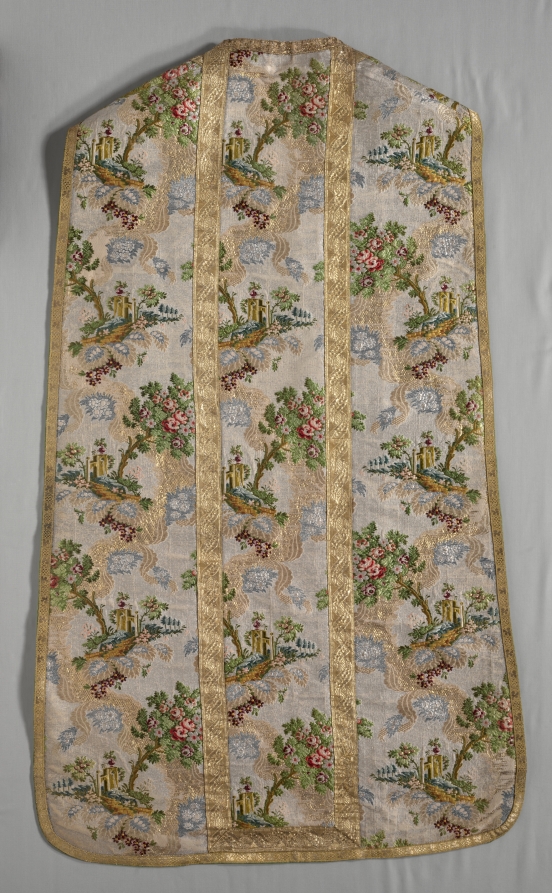
Structural Poetics: The Chasuble as a Dialectic of Restraint and Release
The chasuble, in its ecclesiastical origins, is a garment of pure volume—a draped circle with a central aperture, devoid of tailored seams. For the 2026 executive silhouette, this archetype is subjected to a rigorous architectural reinterpretation. The internal design DNA, drawn from the aesthetic polarity of Han Gan’s *Night Shining White* and Yun Shouping’s *Hundred Flowers*, demands a resolution of opposing forces: the tensile, monochrome dynamism of the Tang horse and the layered, polychromatic serenity of the Qing botanicals. The resulting chasuble is not a robe but a sculpted enclosure, a mobile architecture that negotiates between the body’s kinetic energy and the garment’s static geometry.Geometric Integrity: The Tension of the Tether
The primary structural challenge is to translate the “bound dynamism” of *Night Shining White* into fabric. Han Gan’s masterpiece depicts a horse tethered to a post, its musculature straining against the constraint. This is the core of the chasuble’s geometry: a front panel that is deliberately anchored—a vertical seam or a concealed internal stay at the sternum—creating a fixed axis. From this point, the fabric is allowed to billow and cascade rearward, mimicking the horse’s arrested forward surge. The silhouette is not a simple A-line; it is an asymmetric, forward-weighted volume. The left shoulder (the “tethered” side) is clean and close to the body, while the right side (the “released” side) falls in a deep, uninterrupted sweep. This asymmetry is the garment’s central structural poetics: a visual argument between control and freedom, rendered in pure form. The collar is a critical node. It is not a draped cowl but a precise, architectural ring—a high, standing band that echoes the horse’s halter. This band is cut on a severe bias, creating a subtle torque that lifts the fabric away from the nape, establishing a clear, unbroken line from the jawline to the floor. The armholes are cut deep and low, nearly to the waist, to preserve the integrity of the front panel’s unbroken surface. The sleeve, if present, is a separate, inserted element—a cylindrical, detached sleeve that floats within the chasuble’s volume, never interrupting the primary geometric statement.Color and Materiality: The Onyx Monochrome
The chosen color, Onyx, is a direct reference to the ink-wash aesthetic of *Night Shining White*. It is not a flat black but a deep, mineral black with a subtle, internal luminosity—achieved through a double-faced weave of matte virgin wool on the exterior and a silk-cashmere blend on the interior. The exterior absorbs light, creating a void-like presence; the interior reflects a faint, warm sheen, visible only in the garment’s deep folds. This is the “ink-wash” effect: the fabric itself becomes a medium for tonal variation, where shadows are not cast but *inherent*. The materiality must support the structural poetics. A double-faced wool-cashmere felt is selected for its ability to hold a sharp crease while also draping with a liquid, heavy fall. The front panel is reinforced with a horsehair canvas interlining, not for stiffness, but for a specific, controlled resilience—it will resist the body’s movement, creating the “tension” of the tether. The rear panel is left unlined, allowing it to flow freely. This differential in construction creates a kinetic dialogue: the front is a static, architectural facade; the back is a fluid, painterly gesture.Urban Materiality: The City as Atelier
The 2026 executive operates within a landscape of glass, steel, and concrete. The chasuble must respond to this environment. The Onyx wool felt is chosen for its acoustic properties—it absorbs ambient noise, creating a personal zone of silence. The garment’s weight (approximately 1.8 kg) provides a grounding, gravitational presence, countering the vertiginous verticality of the urban skyline. The deep, low armholes allow for unrestricted arm movement during a commute or a presentation, while the high collar frames the face against the backdrop of a city’s visual noise. The surface finish is a fine, milled texture—neither glossy nor matte, but a “stone” finish that resists water droplets and repels dust. This is not a garment for the pastoral; it is a garment for the transit hub, the boardroom, the gallery opening. Its minimalism is not an absence of detail but a concentration of intent. Every seam is felled, every edge is hand-rolled. The only closure is a single, internal, magnetic clasp at the sternum—invisible, silent, and precise.Conclusion: The Synthesis of Two Poles
This chasuble is the resolution of the aesthetic dialectic presented by Han Gan and Yun Shouping. From *Night Shining White*, it takes the monochrome tension, the bound energy, the existential drama. From the *Hundred Flowers*, it takes the layered depth, the subtle tonal variation, the quiet celebration of material. The Onyx color is the ink; the asymmetric volume is the tether; the double-faced weave is the “没骨” (boneless) layering of color. The garment is a wearable paradox: a static form that suggests perpetual motion, a void that contains light, a restraint that enables freedom. It is the definitive urban silhouette for the executive who understands that true power is not in volume, but in the precise, intentional control of volume.
Technical Insight
Technical Insight: Translating Onyx palettes into Minimalist silhouettes for the modern metropolis.