Tailored
Onyx
Urban Form: Mourner from the Tomb of Philip the Bold, Duke of Burgundy (1364–1404)
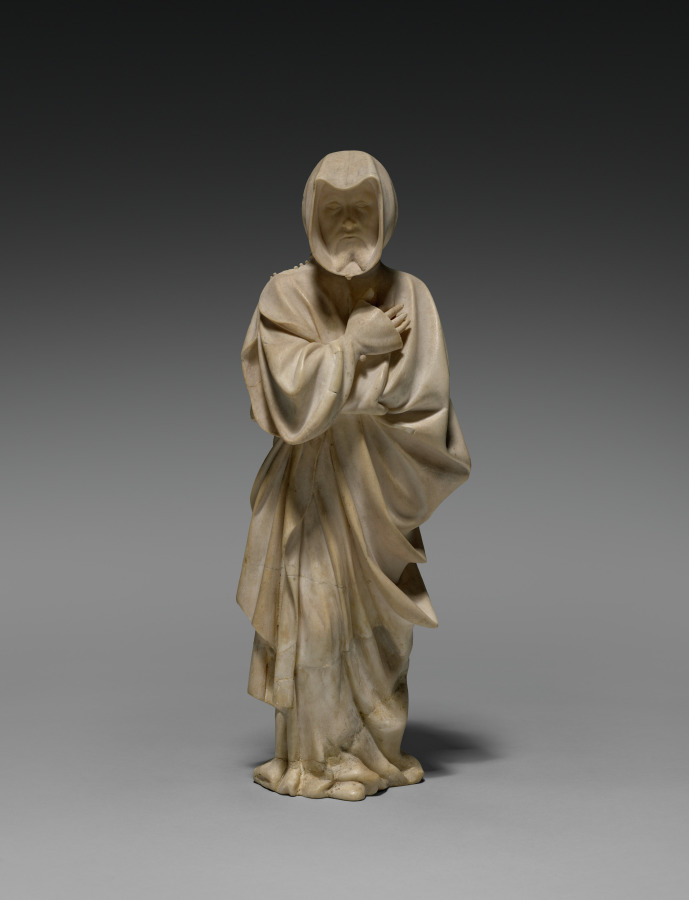
Geometric Integrity of the Mourner: A Study in Structural Poetics
The *Mourner from the Tomb of Philip the Bold* (Claus Sluter, c. 1404) is not merely a sculpture; it is a manifesto of architectural drapery. For the 2026 executive silhouette, this figure provides the definitive lexicon of **tailored compression** and **volumetric release**. The figure’s posture—a bowed, cloaked mass—is a study in controlled gravity. The geometric integrity lies in the inversion of the human form: the shoulders are not broadened but collapsed inward, creating a triangular, almost pyramidal base that tapers to a hidden face. This is not the heroic verticality of classical statuary; it is the **urban poetics of concealment and weight**. The key structural principle is the **“fold as structural beam.”** Sluter’s carving treats the heavy woolen cloak not as fabric but as a series of load-bearing planes. Deep, vertical crevices run from the shoulder to the hem, functioning like fluted columns on a Gothic cathedral. These folds are not soft; they are sharp, angular, and deliberate. For the 2026 executive, this translates into a jacket silhouette where the shoulder seam is dropped and the sleeve head is set low, creating a continuous, unbroken line from the neck to the wrist. The fabric must be rigid enough to hold a crease that mimics a carved stone edge. The **Mourner’s silhouette** is a monolith of grief, and the contemporary executive’s silhouette must be a monolith of authority.Structural Poetics: The Architecture of the Hood and Cowl
The Mourner’s hood is the most radical element. It is not a separate garment but an extension of the body, a **second skin of stone**. The cowl creates a deep, shadowed recess where the face should be, rendering the individual anonymous and subsuming personal identity into the collective ritual of mourning. This is the antithesis of the modern “power shoulder.” The 2026 executive silhouette must embrace this **negative space**. The collar becomes a sculptural element—a high, standing band that wraps the nape of the neck, or a deep, inverted pleat that creates a shadow-box around the throat. The neckline is not a cut; it is a **void**. The poetics here are about **inwardness**. In an era of digital transparency, the Mourner offers a counter-narrative: the power of the unseen. The executive’s jacket should feature a high, mandarin-style collar that rises to the jawline, or a draped cowl-back that creates a sense of hidden volume. The fabric should be heavy—a double-faced wool or a bonded cashmere—so that the collar stands without internal wiring, a pure expression of material gravity. The **urban materiality** is that of a fortress: the garment is a shell, a protective carapace against the city’s noise.Urban Materiality: Onyx and the Weight of Silence
The color Onyx is not a choice; it is a necessity. The Mourner’s stone is a deep, veined limestone, but its emotional register is absolute black. Onyx, in the context of urban fashion, is not merely black. It is a **black with geological memory**—a color that absorbs light rather than reflecting it, creating a surface that feels dense, cool, and impenetrable. This is the color of the corporate monolith, of the skyscraper’s shadow at noon. The materiality of the 2026 executive silhouette must replicate the **tactile weight of stone**. A matte, milled wool with a tight weave; a micro-ribbed jersey that feels like compressed felt; a leather that is aniline-dyed to a depth that appears liquid. The surface must be **anti-reflective**. No sheen, no luster. The garment should read as a solid form, not a textile. This is achieved through construction: fused interlinings, taped seams, and a complete absence of visible stitching. The garment becomes a **monocoque structure**—a single, unified shell.The 2026 Executive Silhouette: A Technical Blueprint
The definitive silhouette derived from the Mourner is the **“Inverted Taper.”** The shoulders are narrow and slightly rounded, the torso is long and lean, and the hem falls straight to the knee, with no flare. The jacket is single-breasted, with a hidden placket and no lapel—the lapel is a distraction, a decorative element that breaks the monolithic surface. The closure is a single, hidden button at the solar plexus, or a series of internal toggles. The sleeve is set in a deep, low armhole, restricting arm movement to create a deliberate, measured gait. This is not a garment for sprinting; it is a garment for **procession**. The trousers are equally architectural: a high waist, a straight leg that falls without break, and a hem that grazes the top of the shoe. The silhouette is **columnar**, echoing the vertical folds of the Mourner’s cloak. The fabric is a heavy, worsted wool in Onyx, with a slight ribbed texture to mimic the striations of stone. The waistband is high and stiff, acting as a corset-like anchor for the entire structure.Conclusion: The Container as Persona
The Mourner from the Tomb of Philip the Bold teaches us that the most powerful silhouette is not the one that reveals, but the one that **contains**. The 2026 executive is not a performer; he is a vessel. The garment is not a costume; it is a **portable architecture**. The Onyx color and the tailored, compressed form create a presence that is felt before it is seen—a gravity, a silence, a weight. This is the urban silhouette of the future: a monument to the self, carved from the stone of the city itself.
Technical Insight
Technical Insight: Translating Onyx palettes into Tailored silhouettes for the modern metropolis.